Integrity is a System Property. Why outcomes reflect design, not intent
Integrity is often treated as a personal trait. This paper shows why it is better understood as a system property — shaped by how authority, accountability, and information are aligned under stress, and why outcomes reflect design rather than intent.
Dr Alwin Tan, MBBS, FRACS, EMBA (University of Melbourne), AI in Healthcare (Harvard Medical School)
Institute for Systems Integrity
Introduction
When failures occur in high-consequence systems, attention usually turns to individuals.
Who made the wrong call?
Who failed to follow the process?
Who lacked integrity?
These questions feel natural. They reflect a deeply held belief that integrity is primarily a personal trait — something people bring (or fail to bring) to their work.
Yet across healthcare, aviation, finance, defence, and other complex domains, a different pattern appears. Outcomes — whether they are safe, harmful, or quietly deteriorating — reflect not just who people are, but the conditions under which they must act.
This paper argues that integrity is a system property.
It emerges from how authority, accountability, and information are aligned under real operating conditions. When these elements drift out of alignment, even capable, ethical people become structurally constrained — and outcomes follow.
This analysis builds on the Institute’s earlier work on:
• Decision-Making Under System Stress
• Why Oversight Fails Under Pressure
• When Resilience Appears, Governance Has Already Failed
and is situated within the Systems Integrity Cascade.
Context
This paper forms part of the Institute for Systems Integrity’s core framework series:
• Decision-Making Under System Stress
• Why Oversight Fails Under Pressure
• When Resilience Appears, Governance Has Already Failed
• The Systems Integrity Cascade
This paper provides the structural explanation that connects all the above.
Why moral explanations fall short
Most professionals working in high-consequence systems care deeply about doing the right thing. They are trained, motivated, and ethically committed.
Yet in Decision-Making Under System Stress, the Institute showed that under sustained pressure:
• Time for reflection contracts
• Information becomes partial and delayed
• Attention narrows to what is immediately survivable
These conditions predictably degrade decision quality — not because integrity disappears, but because systems restrict what integrity can look like in practice.
If integrity were purely a matter of character, these patterns would be random.
They are not.
They recur wherever systems are stressed.
How system conditions shape integrity
Integrity becomes fragile when three structural elements drift out of alignment.
Authority
Who is empowered to decide, allocate resources, and change conditions?
Under stress, people are often expected to deliver outcomes without having authority over the constraints that produce them.
Accountability
Who is held responsible — and how?
Accountability usually activates after harm occurs. When it is not matched with authority and visibility, it becomes punitive rather than corrective.
Information
What is visible, reported, and escalated?
As shown in Why Oversight Fails Under Pressure, stress distorts information flows. Weak signals disappear. Reporting compresses complexity. Oversight becomes selectively blind.
When authority, accountability, and information are misaligned, integrity can no longer be sustained by good intent alone.
Framework
Integrity emerges from the alignment of authority, accountability, and information under real operating conditions.
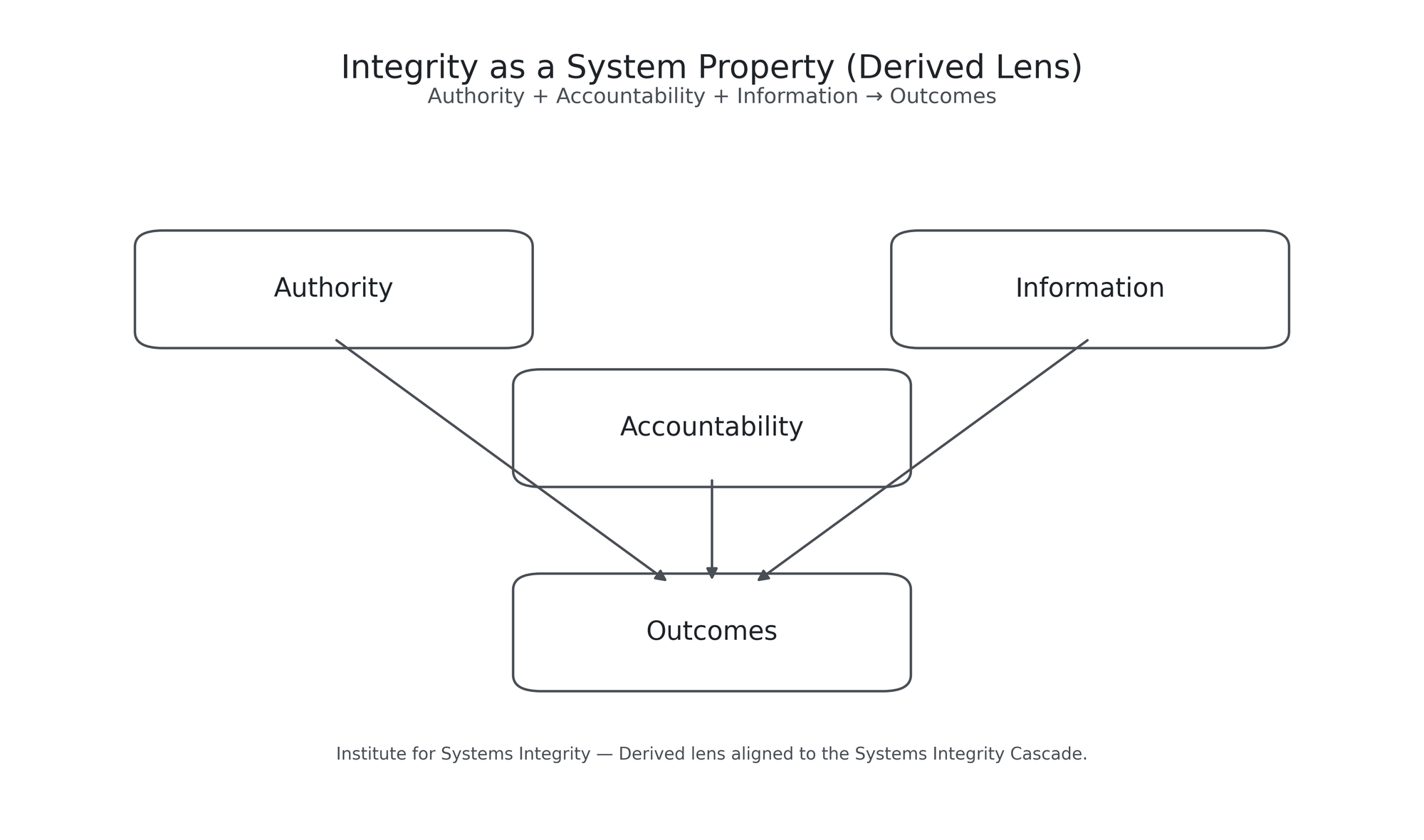
Framework: Integrity as a System Property
Authority + Accountability + Information → Outcomes
When these three elements are aligned, integrity is supported.
When they are misaligned, outcomes degrade — regardless of individual intent.
This lens is derived from the Systems Integrity Cascade
and formalised in:
Integrity as a System Property (Framework)
Integrity as an emergent property
Integrity does not reside in individuals alone.
It emerges from the interaction between people and system design.
When:
• Authority exists without accountability
• Accountability exists without authority
• Information exists without escalation
Even ethical actors become structurally trapped.
The Systems Integrity Cascade shows how system stress shapes decision integrity, how governance mediates visibility, how drift normalises, and how outcomes eventually surface.
The Oversight Blindness Pathway shows how this unfolds under sustained pressure.
The Integrity Alignment Lens explains why those outcomes occur:
Integrity fails when the triad of authority, accountability, and information loses coherence.
From blame to structural response
When harm occurs, organisations often respond with:
• More rules
• Tighter compliance
• Sharper disciplinary action
These assume that integrity resides in individuals.
But if integrity is a system property, these responses treat symptoms while leaving causes untouched. They increase fear and defensiveness while the underlying misalignments persist.
Designing for integrity means building systems that:
• Remain sensitive under stress
• Surface weak signals early
• Align authority with accountability
• Ensure information is timely, valid, and escalated
This is not a cultural intervention.
It is a design obligation.
Implications for governance
For boards, regulators, and institutional leaders, this reframing is decisive.
If integrity is a system property, then:
• Audit must test visibility, not just compliance
• Accountability must be paired with authority
• Dashboards must detect weak signals, not just performance
• Governance must anticipate stress, not merely review failure
Outcomes — good or bad — become indicators of system design, not merely of individual virtue.
Conclusion
Complex systems do not fail because people stop caring.
They fail because stressed systems quietly make it harder for care, judgment, and integrity to be expressed.
Understanding integrity as a system property shifts governance from moral judgement to structural responsibility — and turns outcomes into signals of design.
Related ISI Work
• Decision-Making Under System Stress
• Why Oversight Fails Under Pressure
• When Resilience Appears, Governance Has Already Failed
• The Systems Integrity Cascade
• The Oversight Blindness Pathway
• Integrity as a System Property (Framework)
How to cite this paper
Institute for Systems Integrity (2026).
Integrity Is a System Property: Why Outcomes Reflect Design, Not Intention.
ISI Position Paper No. 4.
 Institute for Systems Integrity
References (Harvard style)
Amalberti, R., Auroy, Y., Berwick, D. and Barach, P. (2005) ‘Five system barriers to achieving ultrasafe health care’, Annals of Internal Medicine, 142(9), pp. 756–764.
Cook, R.I. (1998). How Complex Systems Fail. Chicago: Cognitive Technologies Laboratory.
Dekker, S. (2011). Drift into Failure: From Hunting Broken Components to Understanding Complex Systems. Farnham: Ashgate.
Hollnagel, E. (2014). Safety-I and Safety-II: The Past and Future of Safety Management. Farnham: Ashgate.
Rasmussen, J. (1997) ‘Risk management in a dynamic society’, Safety Science, 27(2–3), pp. 183–213.
Reason, J. (1997). Managing the Risks of Organizational Accidents. Aldershot: Ashgate.
Vaughan, D. (1996). The Challenger Launch Decision. Chicago: University of Chicago Press.
Weick, K.E. and Sutcliffe, K.M. (2007). Managing the Unexpected. 2nd edn. San Francisco: Jossey-Bass.
© 2026 Institute for Systems Integrity. All rights reserved.
Content may be quoted or referenced with attribution.
Commercial reproduction requires written permission.