
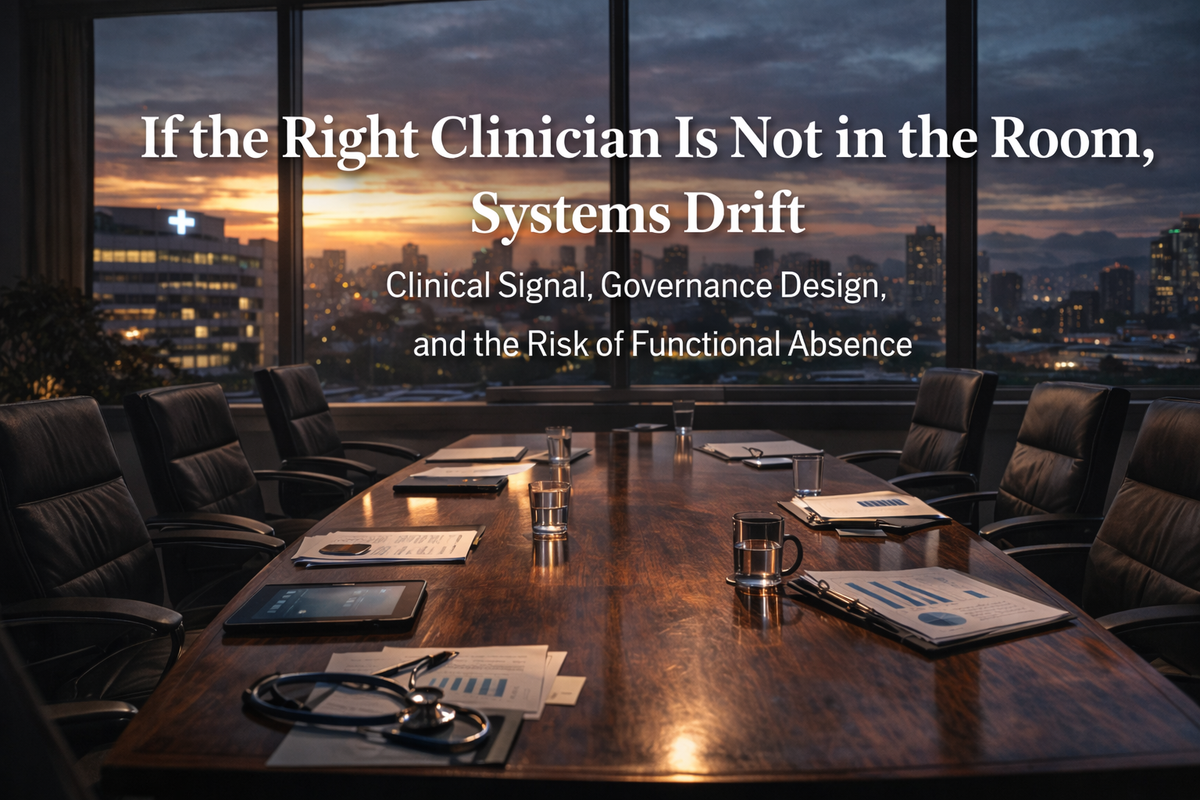
If the Right Clinician Is Not in the Room, Systems Drift: Clinical Signal, Governance Design, and the Risk of Functional Absence
Healthcare systems rarely fail because decisions stop. They fail because decisions continue with weakened clinical signal. This article explores governance blindness, symbolic representation, and why systems drift when the right clinician perspective is absent.
Dr Alwin Tan, MBBS, FRACS, EMBA (Melbourne Business School)
Senior Surgeon | Governance Leader | HealthTech Co-founder
Harvard Medical School — AI in Healthcare
Australian Institute of Company Directors — GAICD candidate
University of Oxford — Sustainable Enterprise
Institute for Systems Integrity (ISI)
Governance. Integrity. Systems.
Executive Summary
Healthcare governance failures rarely arise from poor intent.
They arise when decision systems operate with degraded clinical signal.
A common but under-recognised driver is functional clinical absence — where clinical representation exists, but the right clinician perspective is missing, muted, or structurally constrained.
When this occurs:
• Decisions remain technically sound
• Assumptions receive insufficient challenge
• Operational realities are underweighted
• Implementation friction increases
• Safety margins may narrow
This is not a behavioural issue.
It is a governance design failure.
The Wrong Question
Most boards ask:
“Do we have a clinician?”
This is the wrong question.
The governance-critical question is:
“Does the right clinician meaningfully influence decision quality?”
Because presence alone does not protect governance.
Only functional clinical signal does.
Defining the “Right Clinician” (Governance Context)
From a systems integrity perspective, the right clinician contributes:
• Contemporary operational insight
• Deep understanding of care delivery constraints
• Independence of judgement
• Willingness to challenge assumptions
• Capacity to introduce constructive tension
Clinical expertise without independence becomes advisory.
Clinical presence without challenge becomes symbolic.
Symbolic Representation and the Illusion of Assurance
A recurrent governance pattern:
A clinician is appointed based on:
• Familiarity with leadership
• Cultural alignment
• Perceived agreeability
The role evolves into:
✔ Legitimising presence
✖ Limited assumption challenge
✖ Reduced cognitive diversity
✖ Constrained dissent
This creates the illusion of clinical validation while weakening decision robustness.
Mechanism of Governance Blindness
When the right clinician signal is absent, governance relies on:
• Abstracted metrics
• Financial models
• Policy assumptions
without sufficient testing against frontline realities such as:
• Workflow constraints
• Throughput variability
• Training burden
• Interdependent resource effects
• Safety trade-offs
The decision is not incorrect.
It is under-informed.
Where This Risk Materialises
1️⃣ Technology Investment
Without appropriate clinical challenge:
• ROI assumptions are flattened
• Workflow disruption is underestimated
• Learning curves are ignored
• Downstream impacts are obscured
Result:
• Implementation underperformance
• Friction misattributed to resistance
2️⃣ Clinical Policy
Absent or weakened clinical input leads to:
• Oversimplified care models
• Distorted risk narratives
• Feasibility gaps
Result:
• Policy-practice misalignment
• Workarounds and inefficiency
• Increased system strain
3️⃣ Value-Based Care Decisions
When operational insight is diluted:
• Early intervention value is under-recognised
• Cost-risk assumptions become outdated
Governance Implications
Functional clinical absence degrades:
✔ Information fidelity
✔ Risk calibration
✔ Feasibility assessment
✔ Implementation stability
while preserving:
✔ Procedural compliance
✔ Surface-level consensus
✔ Decision comfort
This creates governance blindness — decisions made without sufficient visibility of real-world consequences.
The Governance Paradox
Boards optimise for:
• Alignment
• Stability
• Collegiality
Yet resilient systems depend on:
• Cognitive diversity
• Constructive tension
• Independent challenge
Especially from those closest to care delivery.
Structural Drivers of Functional Absence
Clinical disengagement is often structural:
• Procedural schedules limit participation
• Governance roles lack protected time
• Contribution is undervalued or symbolic
• Participation is not designed around clinical realities
This is not reluctance.
It is system design failure.
Designing Governance Against Blindness
1️⃣ Selection Integrity
Clinicians selected for:
✔ Currency
✔ Independence
✔ Operational credibility
✔ Willingness to challenge
2️⃣ Explicit Governance Role
Expectation that clinicians:
✔ Stress-test assumptions
✔ Surface constraints
✔ Challenge feasibility
3️⃣ Structural Enablement
• Protected governance time
• Distributed clinician participation
• Scheduling aligned to clinical realities
4️⃣ Diversity of Clinical Input
Avoid reliance on:
✖ A single “clinical voice”
Reframing Governance
Not:
“Do we have clinical representation?”
But:
“Does clinical expertise function as an active governance control?”
Conclusion
Healthcare systems do not fail because clinicians are absent.
They fail when the wrong clinical signal shapes decisions — or when the right signal is missing.
Because if the right clinician is not in the room,
governance does not stop.
It continues —
with weaker visibility,
reduced challenge,
and increased risk.
That is governance blindness.
References (Harvard Style)
Australian Commission on Safety and Quality in Health Care (ACSQHC) 2017, National Model Clinical Governance Framework, ACSQHC, Sydney.
Australian Institute of Company Directors (AICD) 2019, Good Governance Principles and Guidance for Not-for-Profit Organisations, 4th edn, AICD, Sydney.
Brown, A 2019, ‘Governing the quality and safety of healthcare: A conceptual framework’, Social Science & Medicine, vol. 238, 112–117.
Prenestini, A, Lega, F & Masella, C 2023, ‘Physician engagement in health care organizations: A systematic review’, BMC Health Services Research, vol. 23, no. 1.
Royal Australasian College of Surgeons (RACS) 2017, Clinical Governance Frameworks Report, RACS, Melbourne.
Safer Care Victoria 2017, Victorian Clinical Governance Framework, Victorian Government, Melbourne.
World Health Organization (WHO) 2014, Strengthening clinical governance for quality and safety, WHO, Geneva.
World Health Organization (WHO) 2021, Global Patient Safety Action Plan 2021–2030, WHO, Geneva.