Absenteeism in Healthcare: From Workforce Symptom to System Signal
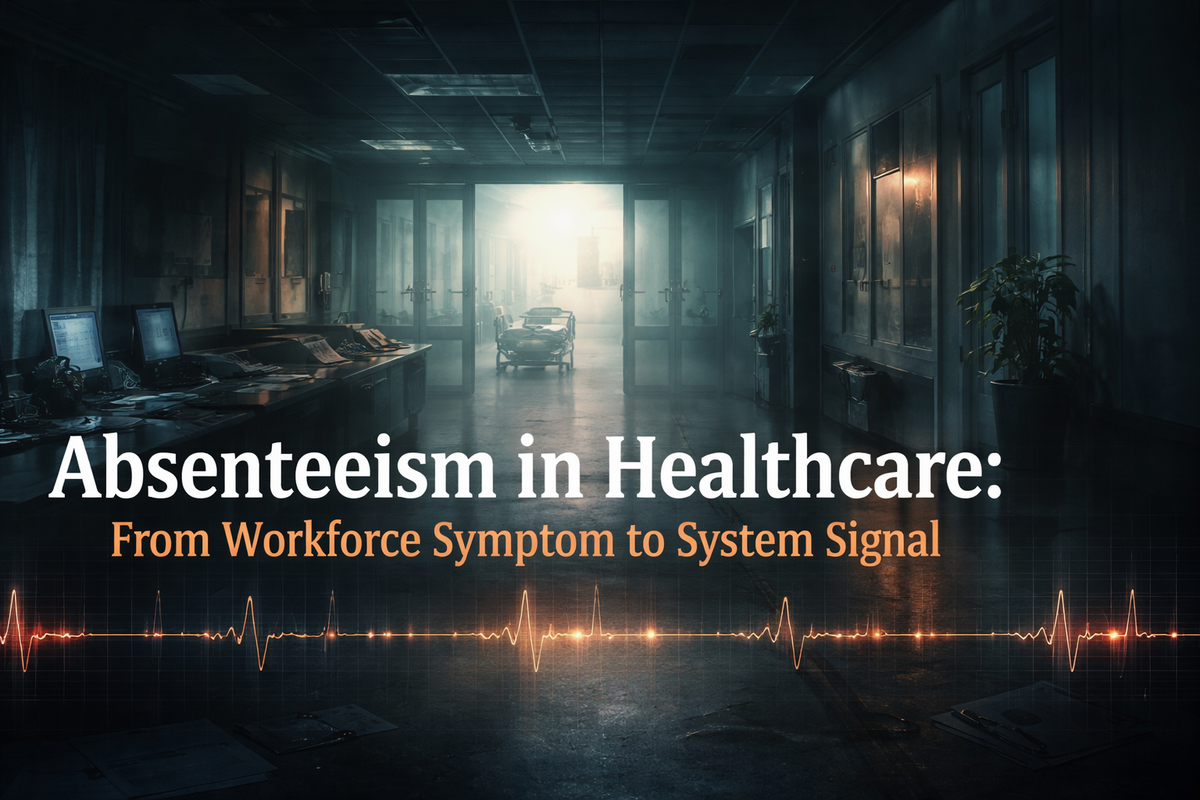
Absenteeism in healthcare is often treated as a workforce issue. This ISI analysis reframes it as an early signal of system strain — revealing deeper pressures in workforce design, operational flow and organisational culture with direct implications for patient safety.
A Systems Integrity Perspective on Workforce Sustainability
Co-authors:
Florinda Frentescu, BNurs.(Monash),BSc.(Monash)
Senior Nurse Manager | MBA Candidate, Melbourne Business School | HealthTech Co-Founder | Harvard Business School (Sustainability) | Monash Science Alum | Bastas Academy for Healthcare Leadership Alum
Dr Alwin Tan, MBBS, FRACS, EMBA (Melbourne Business School)
Senior Surgeon | Governance Leader | HealthTech Co-founder
Harvard Medical School — AI in Healthcare
Australian Institute of Company Directors — GAICD candidate
University of Oxford — Sustainable Enterprise
Institute for Systems Integrity (ISI)
Introduction
Absenteeism in healthcare is commonly framed as a workforce management problem.
A shift must be covered.
A roster adjusted.
An agency nurse called.
These responses are operationally necessary, but they rarely address the underlying issue.
Across healthcare systems internationally, absenteeism patterns increasingly reflect something deeper: system pressure within the workforce environment.
When absenteeism rises within clinical teams, it often signals structural challenges in workload design, staffing models, leadership culture and organisational resilience.
Importantly, this pressure is not confined to one profession.
While nurses frequently experience the impact first at the bedside, similar dynamics affect doctors in training, senior medical staff and allied health professionals across the healthcare system.
From a systems integrity perspective, absenteeism is therefore not simply an attendance issue. It is an early signal of strain within complex healthcare systems.
Healthcare as a Complex Adaptive System
Healthcare organisations operate as complex adaptive systems in which workforce capacity, patient demand and clinical decision-making are tightly interconnected.
In these environments, small disruptions in staffing levels can propagate rapidly across operational layers.
When staff availability declines:
Workload increases for remaining staff.
Fatigue accumulates.
Communication becomes compressed.
Clinical decision-making becomes more demanding.
Research has consistently demonstrated associations between healthcare worker burnout, reduced staff wellbeing and increased patient safety risks (Hall et al., 2016; Li et al., 2024).
These dynamics create reinforcing feedback loops within the system.
Workload pressure → fatigue → burnout → absenteeism → further workload pressure
Without intervention, such loops gradually erode organisational resilience.
The Cultural Dimension: “Just Toughen Up”
One of the most enduring features of healthcare culture is the expectation of personal resilience.
Many clinicians have heard variations of the same message throughout training:
“Just toughen up.”
“You chose this profession.”
“This is how medicine has always been.”
Historically, these messages reflected the demanding nature of healthcare work.
However, they can also obscure systemic problems.
Junior doctors often work long hours while navigating steep learning curves and significant responsibility.
Nurses frequently manage high patient acuity and emotional labour.
Allied health professionals must coordinate complex care across multiple disciplines.
When system pressures intensify, the expectation of personal endurance can discourage clinicians from recognising or reporting workplace strain.
As a result, problems that are fundamentally system design issues may be interpreted as individual resilience failures.
This cultural dynamic can delay organisational recognition of workforce stress signals.
The Nursing Interface of System Pressure
Within healthcare organisations, nurses often encounter these pressures first.
Nursing roles sit at the intersection of patient care, multidisciplinary coordination and operational continuity.
When staffing shortages occur, the workload rarely disappears.
Instead, it redistributes across the clinical team.
Patient assignments expand.
Monitoring responsibilities increase.
Administrative tasks compress into limited time.
Despite these pressures, expectations for safe and compassionate care remain unchanged.
Evidence demonstrates that nurse staffing levels are strongly associated with patient outcomes, including mortality and quality indicators (Aiken et al., 2014).
Rising absenteeism among nursing teams can therefore represent an early indicator of system strain.
Doctors in Training and Workforce Pressure
Doctors in training experience a different but equally significant set of pressures.
Extended working hours, complex clinical decisions and high educational expectations create demanding environments.
While reforms have improved working conditions in many health systems, cultural expectations of endurance remain strong.
Junior doctors may hesitate to report fatigue or illness due to concerns about professional reputation or training progression.
These dynamics contribute to both presenteeism and burnout within the medical workforce.
From a systems perspective, the challenge lies not in the resilience of individual doctors but in ensuring that training environments remain sustainable.
Allied Health: The Coordination Backbone
Allied health professionals are another essential but often overlooked component of workforce sustainability.
Physiotherapists, pharmacists, psychologists, occupational therapists and many other professionals play critical roles in coordinating patient recovery and discharge planning.
When workforce shortages occur in these areas, the effects ripple across the system.
Delayed rehabilitation may extend hospital stays.
Medication reviews may be postponed.
Discharge planning may slow.
These disruptions increase pressure on the broader healthcare system and contribute to operational bottlenecks.
Presenteeism: The Hidden Workforce Risk
Absenteeism statistics capture only part of the workforce story.
Healthcare environments frequently experience presenteeism, where staff attend work despite illness, fatigue or psychological distress.
Professional commitment, team loyalty and concern for patients often encourage clinicians to continue working even when unwell.
However, presenteeism introduces its own risks.
Fatigue can impair concentration and decision-making.
Communication errors become more likely.
Recovery from illness may be delayed.
Research shows that burnout among healthcare professionals is associated with increased risk of medical errors and lower patient satisfaction (Li et al., 2024).
Organisations focusing solely on reducing absenteeism may therefore shift risk toward patient safety if underlying workload pressures remain unaddressed.
Fragmented Data and Organisational Blind Spots
Another challenge lies in how healthcare organisations interpret workforce data.
Indicators related to absenteeism are often distributed across different organisational domains.
Human resources teams track sick leave patterns.
Operational teams monitor staffing shortages.
Finance departments observe rising agency costs.
Clinical governance units analyse incident reports.
Occupational health teams track injuries and psychological risk.
When examined separately, these datasets appear manageable.
When integrated, they frequently reveal systemic patterns linking workforce strain with operational and safety indicators.
Without this integration, organisations risk treating absenteeism as an individual issue rather than a system design challenge.
Psychosocial Risk and Workforce Sustainability
Increasingly, regulatory frameworks recognise that workplace psychosocial hazards must be managed alongside physical safety risks.
Factors such as excessive workload, workplace aggression, emotional labour and lack of psychological safety can significantly affect workforce wellbeing.
Safe Work Australia (2022) emphasises that organisations must identify and manage psychosocial hazards in the workplace.
Within healthcare environments, these hazards may arise from:
• high patient acuity
• unpredictable workloads
• exposure to trauma and distress
• insufficient recovery time between shifts
Addressing absenteeism therefore requires a broader focus on workforce sustainability and organisational culture.
Leadership and System Design
For healthcare leaders, absenteeism should be interpreted as a leadership signal.
Key questions include:
Are staffing models aligned with patient demand?
Are training environments sustainable for junior clinicians?
Do workplace cultures support psychological safety?
Is workforce data integrated with patient safety monitoring?
Organisations that respond effectively to absenteeism rarely rely on attendance policies alone.
Instead, they strengthen the underlying conditions that support workforce resilience.
Absenteeism and Systems Integrity
The Institute for Systems Integrity emphasises the importance of recognising early signals within complex organisations.
Absenteeism represents one such signal.
When workforce absence patterns increase, they often reveal deeper structural pressures within the healthcare system.
Leaders who recognise and investigate these signals early can address root causes before they escalate into burnout, workforce attrition or patient safety incidents.
In this sense, absenteeism becomes not simply a workforce metric but a systems integrity indicator.
Conclusion
Healthcare systems rely fundamentally on the wellbeing and capability of their workforce.
Absenteeism, when viewed narrowly, appears to be a problem of attendance.
When viewed through a systems integrity lens, it becomes something more significant: an early signal of strain within complex healthcare systems.
Importantly, these pressures affect the entire healthcare workforce — nurses, doctors and allied health professionals alike.
Addressing them requires moving beyond expectations of individual resilience and toward thoughtful system design.
Leaders who recognise these signals early strengthen workforce sustainability and patient safety.
Those who overlook them risk discovering the underlying problems only after they manifest in burnout, workforce attrition or compromised care.
In complex healthcare environments, interpreting these signals correctly is not simply a workforce management skill.
It is a leadership and governance capability.
References
Aiken, L.H., Sloane, D.M., Bruyneel, L., Van den Heede, K. and Sermeus, W. (2014) ‘Nurse staffing and education and hospital mortality in nine European countries: A retrospective observational study’, The Lancet, 383(9931), pp. 1824–1830.
Hall, L.H., Johnson, J., Watt, I., Tsipa, A. and O’Connor, D.B. (2016) ‘Healthcare staff wellbeing, burnout, and patient safety: A systematic review’, PLOS ONE, 11(7), e0159015.
Li, L., Ai, H., Gao, L., Zhou, H., Liu, X., Zhang, Z. and Fan, L. (2024) ‘Burnout and its association with patient safety, patient satisfaction and quality of care: A systematic review and meta-analysis’, JAMA Network Open, 7(10).
Safe Work Australia (2022) Model Code of Practice: Managing psychosocial hazards at work. Canberra: Safe Work Australia.
World Health Organization (2020) Health worker safety: A priority for patient safety. Geneva: WHO.