Why Oversight Fails Under Pressure: How system stress distorts visibility, weakens governance, and produces predictable outcomes
Governance systems are designed for stability. Under sustained stress, visibility distorts, oversight becomes selectively blind, drift normalises, and outcomes become predictable.

Dr Alwin Tan, MBBS, FRACS, EMBA (University of Melbourne), AI in Healthcare (Harvard Medical School)
Institute for Systems Integrity
Introduction
Most governance systems are designed for stability.
They assume manageable demand, sufficient time for deliberation, and reporting pathways that accurately reflect what is happening within the system. Under these assumptions, oversight mechanisms—audits, assurance processes, committees, and escalation protocols—appear to function as intended.
But serious failures rarely occur under stable conditions.
They emerge when systems operate under sustained stress: rising demand, constrained capacity, compressed timelines, and persistent uncertainty. Under these conditions, governance does not usually fail through sudden breakdown or negligence. It fails quietly.
Oversight becomes progressively disconnected from system reality.
This paper examines why governance mechanisms often lose visibility under system stress, how this loss of visibility enables system drift, and why the outcomes that follow are best understood as products of system design rather than individual decision-making failure.
System stress and distorted visibility
System stress changes what can be seen.
As pressure increases, attention shifts toward immediate operational demands: throughput, backlog management, crisis response, and exception handling. Information that does not appear urgent—weak signals, near misses, emerging risks—is increasingly filtered out or deprioritised.
Governance structures depend on what survives this filtering.
Reports summarise complexity, dashboards compress variation, and escalation pathways narrow the range of information presented to oversight bodies. As a result, what governance “sees” is not the system as it is being experienced, but a partial, lagging representation of it.
Under sustained stress, this gap widens.
By the time risks are clearly visible at the level of oversight, they are often already embedded in routine practice.
Governance blindness under non-normal conditions
Most governance frameworks implicitly assume normal operating conditions.
They rely on thresholds, exception reporting, and retrospective review. These mechanisms perform adequately when variation is limited and capacity margins exist. Under prolonged stress, however, they lose sensitivity.
Escalation pathways clog. Reporting becomes compliance-shaped rather than risk-shaped. Oversight attention is drawn toward what is formally measurable rather than what is structurally concerning.
Governance does not stop functioning, but it becomes selectively blind.
This blindness is not the result of indifference or incompetence. It is an emergent property of governance systems operating beyond the conditions for which they were designed.
Drift and the normalisation of adaptation
Under stress, systems adapt.
Workarounds emerge, thresholds shift, and informal practices develop to maintain function in the face of constraint. From within the system, these adaptations are often experienced as necessary, reasonable, and even responsible.
Over time, adaptation becomes normalised.
What began as a temporary adjustment becomes routine practice. Risk migrates gradually, without triggering formal alarms. Documentation and formal processes often lag behind actual work, further reducing governance visibility.
This process—commonly described as system drift—does not feel like failure from the inside. It feels like coping.
The oversight blindness pathway (derived view)
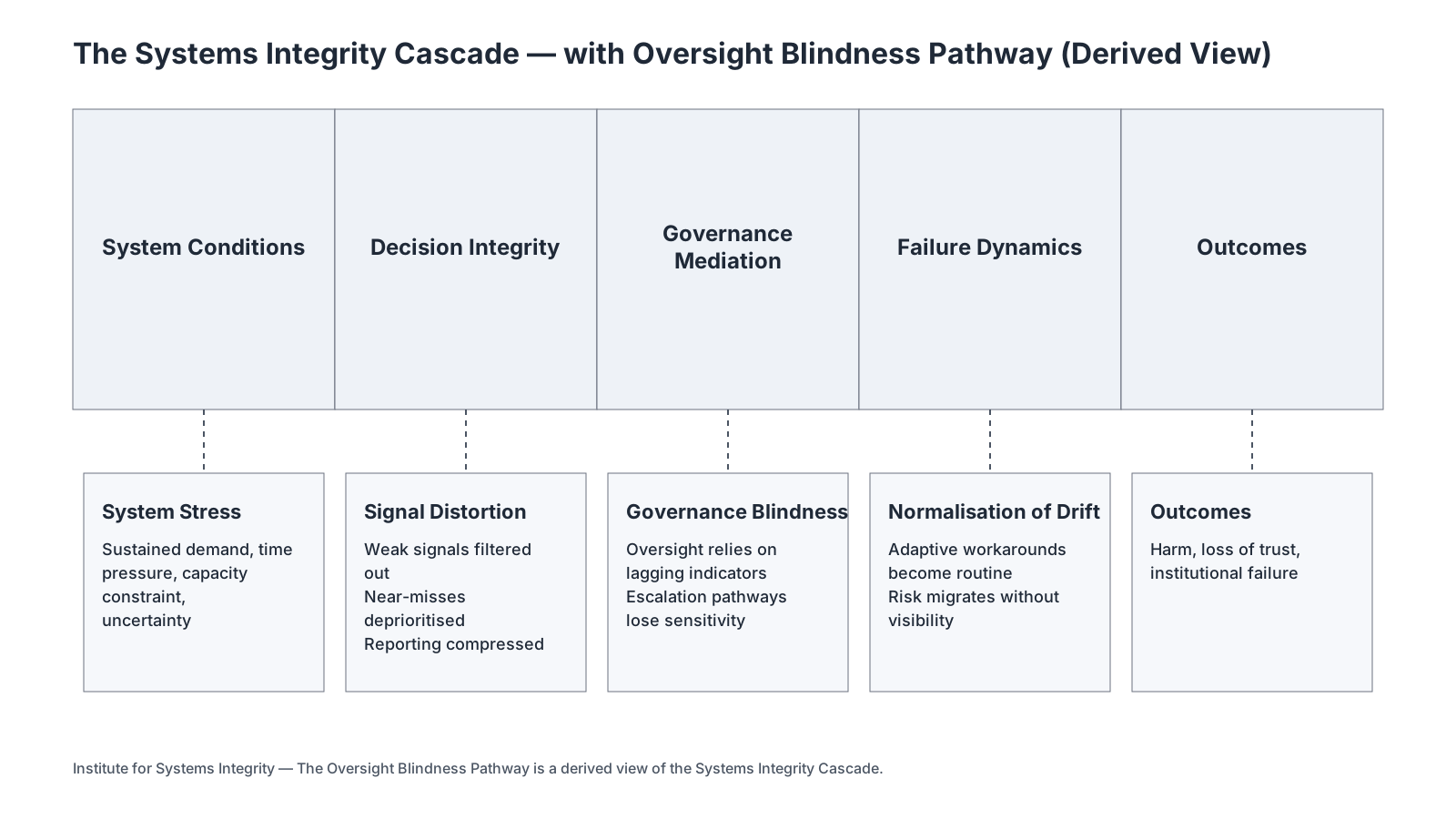
The Systems Integrity Cascade — with Oversight Blindness Pathway (Derived View)
This pathway presents a simplified view of how the Systems Integrity Cascade unfolds under sustained system stress.
Under pressure, the interaction between system conditions and governance mediation produces a recognisable pattern:
- System Stress distorts operational priorities
- Signal Distortion filters out weak but meaningful indicators
- Governance Blindness emerges as oversight relies on lagging information
- Normalisation of Drift embeds risk into routine practice
- Outcomes appear sudden, despite being long-incubated
This pathway is not a separate framework.
It is a derived view of the Systems Integrity Cascade, intended to make visible how oversight fails quietly under non-normal conditions.
🔗 Link here: Frameworks → The Systems Integrity Cascade
Retrospective accountability and the illusion of control
When adverse outcomes occur, accountability mechanisms activate.
Investigations focus on decision points, procedural compliance, and individual actions. These inquiries matter, but they often reconstruct events using documentation that was never designed to capture system stress in real time.
As a result, governance responses may over-emphasise individual decision-making while under-examining the conditions that shaped those decisions.
This creates an illusion of control.
By locating failure in discrete actions, systems avoid confronting the structural factors that made those actions likely. The underlying governance arrangements remain unchanged, allowing similar patterns to recur.
Outcomes as system properties
The outcomes that follow—harm, loss of trust, institutional failure—are rarely sudden or accidental.
They are the predictable result of sustained system stress interacting with governance structures that lack early-warning sensitivity and adaptive oversight.
From this perspective, outcomes are not primarily expressions of individual intent or competence. They are system properties.
Integrity, therefore, cannot be reduced to character, culture, or compliance alone. It must be understood as an emergent property of how authority, accountability, and information are aligned under real operating conditions.
(This concept is examined further in Integrity Is a System Property, Article 4.)
🔗 Link here: Article 4 to follow
Conclusion
Governance failures under pressure are rarely dramatic.
More often, governance becomes progressively blind—distorted by stress, disconnected from system reality, and activated only after drift has hardened into outcomes.
Recognising this pattern is essential. Designing governance that remains effective under non-normal conditions is the work that follows.
Related work
- 🔗 Decision-Making Under System Stress (Article 1)
- 🔗 The Systems Integrity Cascade (Framework)
- Oversight Blindness Pathway (Derived View)
- 🔗 Integrity Is a System Property (Article 4) to follow
How to cite this paper
Institute for Systems Integrity (2026). Why Oversight Fails Under Pressure: How system stress distorts visibility, weakens governance, and produces predictable outcomes. systemsintegrity.org.
References
Amalberti, R., Auroy, Y., Berwick, D., and Barach, P. (2005). Five system barriers to achieving ultrasafe health care. Annals of Internal Medicine, 142(9), pp.756–764.
Cook, R.I. (1998). How Complex Systems Fail. Chicago: Cognitive Technologies Laboratory.
(Also available as a widely cited technical report.)
Dekker, S. (2011). Drift into Failure: From Hunting Broken Components to Understanding Complex Systems. Farnham: Ashgate Publishing.
Hollnagel, E. (2014). Safety-I and Safety-II: The Past and Future of Safety Management. Farnham: Ashgate Publishing.
Hollnagel, E. (2015). From Safety-I to Safety-II: A White Paper. Brussels: Eurocontrol.
Rasmussen, J. (1997). Risk management in a dynamic society: a modelling problem. Safety Science, 27(2–3), pp.183–213.
Reason, J. (1990). Human Error. Cambridge: Cambridge University Press.
Reason, J. (1997). Managing the Risks of Organizational Accidents. Aldershot: Ashgate Publishing.
Vaughan, D. (1996). The Challenger Launch Decision: Risky Technology, Culture, and Deviance at NASA. Chicago: University of Chicago Press.
Weick, K.E. and Sutcliffe, K.M. (2007). Managing the Unexpected: Resilient Performance in an Age of Uncertainty. 2nd ed. San Francisco: Jossey-Bass.
© 2026 Institute for Systems Integrity. All rights reserved.
Content may be quoted or referenced with attribution.
Commercial reproduction requires written permission.