When the Constitution Becomes a Weapon. - How governance drift turns compliance into a liability under system stress
Governance failure rarely begins with misconduct. It begins when constitutions, delegations, decisions, and oversight drift out of alignment under pressure. This paper explains how compliance can persist even as integrity quietly erodes.
Dr Alwin Tan, MBBS, FRACS, EMBA (University of Melbourne), AI in Healthcare (Harvard Medical School)
Senior Surgeon | Governance Leader | HealthTech Co-founder |Harvard Medical School — AI in Healthcare |
Australian Institute of Company Directors — GAICD candidate
University of Oxford — Sustainable Enterprise
Institute for Systems Integrity (ISI)
Abstract
Boards rarely fail by ignoring the law. More often, they fail while remaining fully compliant.
This paper explains how governance architecture—constitutions, delegations, decision rights, and oversight—can drift out of alignment with how decisions are actually made under sustained pressure.
Building on ISI’s foundational work on integrity, decision-making under stress, and oversight failure, it introduces The ISI Governance Control Loop as a core framework for understanding where governance breaks down.
The paper shows why compliance can persist even as integrity erodes, and why failure is often structurally embedded long before harm becomes visible.
Introduction
This paper builds on the Institute for Systems Integrity’s foundational analysis of governance failure under system stress.
In Integrity Is a System Property, ISI established that integrity outcomes reflect system design rather than individual intent.
Decision-Making Under System Stress demonstrated how pressure predictably weakens judgment, even among capable and well-intentioned leaders.
Why Oversight Fails Under Pressure showed how visibility degrades, and governance becomes selectively blind as complexity increases.
Finally, When Resilience Appears, Governance Has Already Failed explained how frontline heroics mask upstream design failure rather than resolve it.
This paper extends that arc by examining where governance failure becomes structurally embedded. It focuses on constitutions, delegations, and formal authority arrangements that remain legally intact while drifting away from real decision-making. It introduces The ISI Governance Control Loop to show how compliance can persist even as integrity quietly erodes—and why governance failure is often locked in long before outcomes force attention.
1. The compliance illusion
After major failures, reviews often conclude with a familiar phrase: “All procedures were followed.”
Meetings were held. Papers were tabled. Decisions were minuted. Legal advice was obtained.
This is usually taken as evidence of good governance. Often, it is the opposite.
Compliance confirms that rules were followed. Integrity asks whether those rules still worked under real conditions. Under sustained system stress, organisations can remain compliant while governance becomes ineffective.
2. What the law is designed to do
Australian governance rests on three formal elements:
- Statutory law, primarily the Corporations Act 2001 (Cth) and related legislation
- Common law, which shapes how directors’ duties are interpreted
- The constitution, which allocates authority, process, and decision rights
Together, these establish minimum standards of conduct and accountability. What they do not do is ensure that governance structures continue to reflect reality as complexity, urgency, and risk increase. That responsibility sits with the board.
3. Governance drift under system stress
As demonstrated in Decision-Making Under System Stress and Why Oversight Fails Under Pressure, stress produces predictable adaptations. Authority is delegated to maintain speed. Reporting is simplified to reduce overload. Escalations are softened to preserve confidence.
None of this requires bad intent. Each adjustment may appear reasonable in isolation. The risk emerges when these adaptations accumulate without corresponding changes to governance design.
Over time, a gap opens between:
- Formal authority, as set out in constitutions and delegations; and
- Practical control, as exercised through day-to-day decisions.
Compliance continues. Governance drifts.
4. Framework: The ISI Governance Control Loop
To understand where governance breaks down, ISI frames governance as a closed-loop control system rather than a static set of rules.
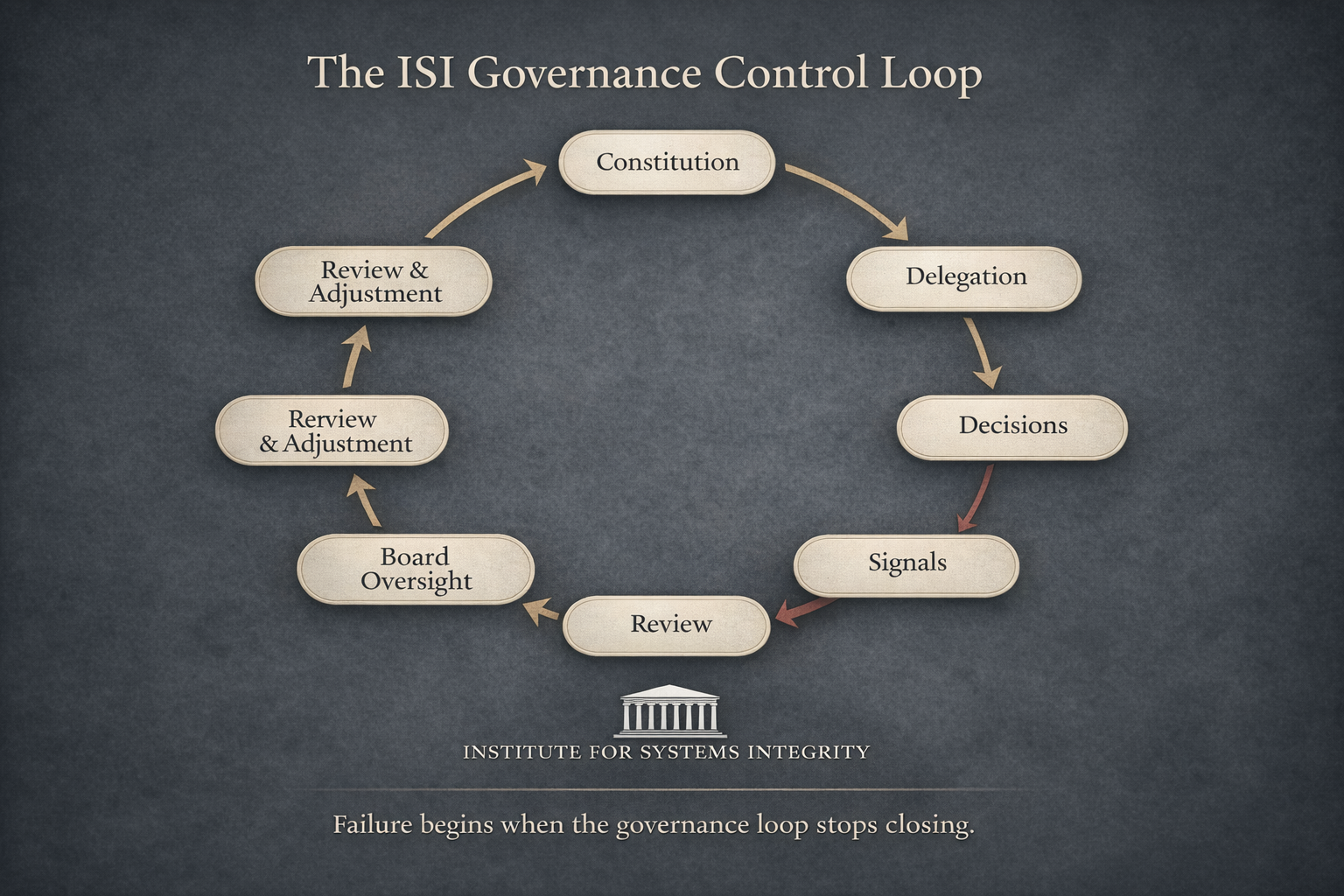
The ISI Governance Control Loop
Constitution
→ Delegation
→ Decisions
→ Signals
→ Board Oversight
→ Review & Adjustment
→ (back to Constitution)
This loop explains how authority, accountability, and information are meant to remain aligned over time. Integrity is maintained when the loop continues to close.
A detailed explanation of the framework is available here:
Frameworks - the-isi-governance-control-loop
5. Where the loop breaks
Under sustained pressure, the loop most often fails at the Signals → Oversight → Review stages.
- Information reaching the board becomes filtered, delayed, or sanitised
- Leading indicators disappear
- Assurance replaces insight
- Review occurs without structural adjustment
At this point, the organisation may remain fully compliant while governance loses control.
This is the mechanism described in Why Oversight Fails Under Pressure, now made structurally explicit.
(Framework: Oversight blindness pathway)
6. How constitutions fail without being breached
Constitutions are rarely broken outright. They fail more quietly by becoming irrelevant to how decisions are actually made. ISI consistently observes four failure patterns:
- Delegation creep — authority expands without stronger evidence or escalation
- Meeting compliance theatre — meetings occur, but risk trade-offs are not interrogated
- Replaceable-rule blindness — default rules persist despite increased complexity
- Accountability inversion — responsibility flows downward while authority remains insulated
These patterns sit directly beneath the resilience dynamics described in When Resilience Appears, Governance Has Already Failed.
7. Why this matters
When governance architecture drifts out of alignment:
- Compliance often increases
- Transparency decreases
- Accountability shifts downward
- Harm becomes predictable
By the time outcomes become visible, the system that produced them is already embedded. The constitution did not prevent failure. It normalised it.
Conclusion
The law sets the minimum standard for conduct. Constitutions allocate authority. Governance determines whether either still functions under pressure.
Failure does not arrive suddenly. It unfolds through drift, signal loss, and accountability inversion—long before outcomes force attention. This is the structural foundation on which predictable failure is built, and the starting point for The ISI Failure Taxonomy
Integrity is not lost when rules are broken.
It is lost when rules remain intact while the governance loop stops closing.
How this paper fits the ISI canon
This paper:
- Builds on Integrity is a System Property
- Extends Decision-Making Under System Stress
- Makes explicit the mechanisms in Why Oversight Fails Under Pressure
- Connects directly to When Resilience Appears, Governance Has Already Failed
- Introduces the ISI Governance Control Loop as a core framework
- Prepares the ground for the ISI Failure Taxonomy and the Systems Integrity Toolkit (to follow)
References (Harvard style)
Australian Charities and Not-for-profits Commission (ACNC) n.d., Governance standards, ACNC, Canberra.
Australian Securities and Investments Commission (ASIC) n.d., Directors’ duties, ASIC, Canberra.
Commonwealth of Australia 2001, Corporations Act 2001 (Cth), Australian Government, Canberra.
Commonwealth of Australia 2012, Australian Charities and Not-for-profits Commission Act 2012 (Cth), Australian Government, Canberra.
Office of the Registrar of Indigenous Corporations (ORIC) n.d., Corporations (Aboriginal and Torres Strait Islander) Act 2006 (CATSI Act) governance resources, ORIC, Canberra.
© 2026 Institute for Systems Integrity. All rights reserved.
Content may be quoted or referenced with attribution.
Commercial reproduction requires written permission.