
The Pause Principle as a Governance Control Condition
A governance framework explaining how the loss of pause accelerates failure under pressure — and why calm must be designed into systems, not demanded of individuals.
Institute for Systems Integrity (ISI)
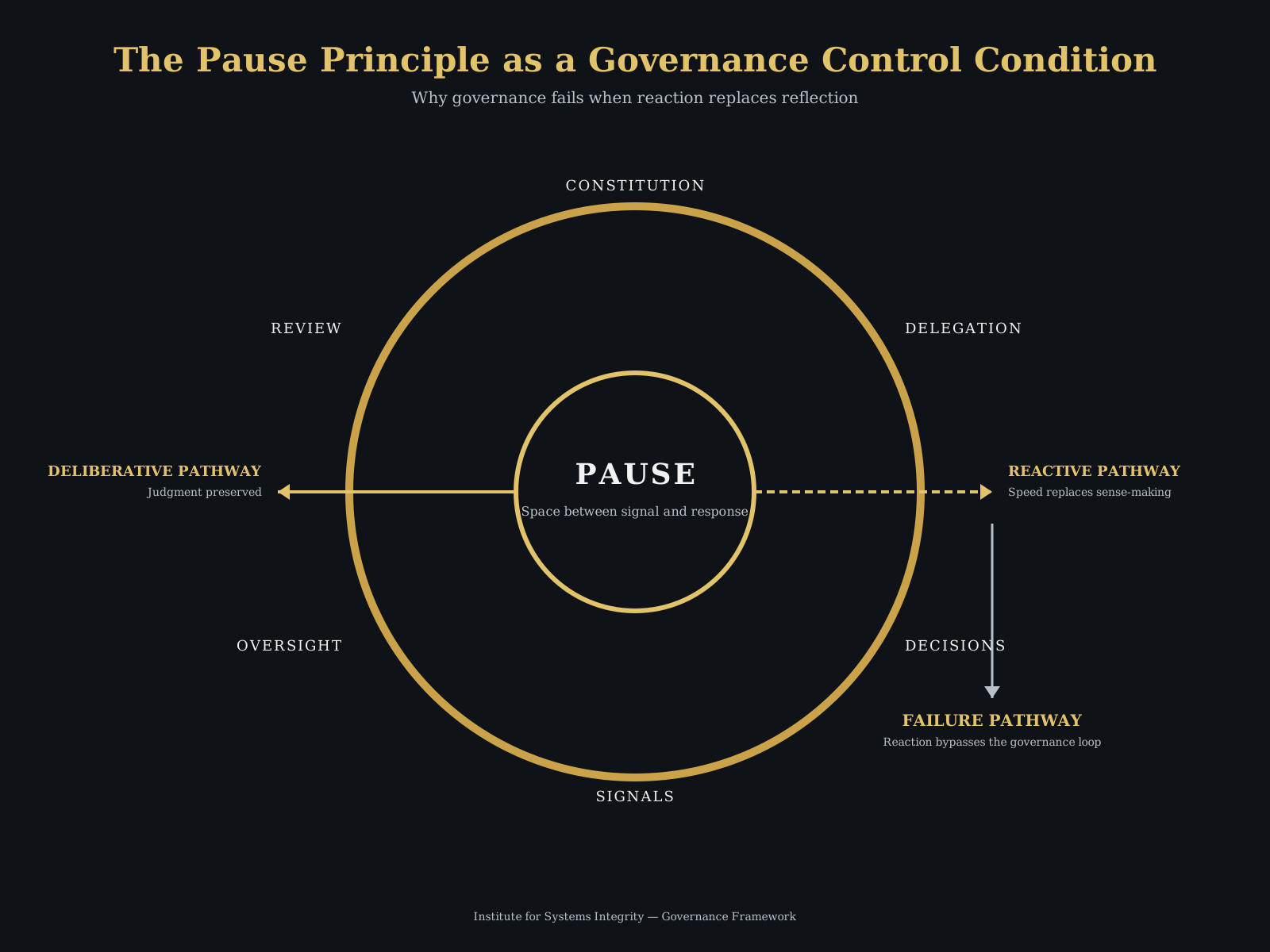
The Pause Principle defines a necessary condition for effective governance.
When systems remove space between signal and response, judgment degrades, accountability inverts, and failure accelerates.
Pause is not a behavioural preference — it is a control condition
The Pause Principle defines a necessary control condition for effective governance:
Governance integrity depends on preserved space between signal and response at every stage of the control loop.
This space — the pause — is not discretionary. It is the condition that allows judgment, accountability, and integrity to remain operational under pressure.
The framework has four components:
1. Trigger Conditions
System stressors such as time compression, information overload, escalating stakes, and reputational threat increase decision velocity. These conditions narrow cognitive bandwidth and incentivise action over interpretation.
2. Control Loop Impact
As pressure rises, pause is consumed unevenly across the governance loop:
- decisions accelerate
- signals flatten or degrade
- oversight shifts from anticipatory to retrospective
The loop remains active in form, but its regulating function weakens.
3. Failure Pathway
When pause is lost, reaction substitutes for judgment. Authority advances faster than accountability, and responsibility is displaced downward. This produces the characteristic sequence described in the Failure Taxonomy: drift, normalisation, signal loss, and accountability inversion — often before harm becomes visible.
4. Design Safeguards
Pause must be structurally protected. Effective systems embed it through decision gates, escalation protection, temporal buffers, and oversight pacing. These mechanisms preserve optionality and prevent irreversible momentum in the wrong direction.
The Pause Principle explains how governance failure accelerates under pressure and provides the structural basis for the Systems Integrity Toolkit — Phase I.(to follow)
Related ISI frameworks
- Integrity Is a System Property
- The Failure Taxonomy
- Decision-Making Under System Stress
- The Governance Control Loop
- Systems Integrity Toolkit — Phase I (forthcoming)
Citation:
The Pause Principle is a governance framework developed by the Institute for Systems Integrity that defines pause as a necessary control condition within decision systems. It explains how the loss of space between signal and response under pressure degrades judgment, distorts signals, and accelerates governance failure. Rather than treating calm as a personal attribute, the framework locates pause as a structural requirement of effective governance, linking system stress to the failure pathways described in the ISI Failure Taxonomy
© 2026 Institute for Systems Integrity. All rights reserved.
Content may be quoted or referenced with attribution.
Commercial reproduction requires written permission.