The ISI Pause Principle: Why governance fails when reaction replaces reflection
A systems analysis of how urgency compresses judgment, suppresses signals, and accelerates governance failure — and why pause must be designed as a control condition.
By Dr Alwin Tan, MBBS, FRACS, EMBA (Melbourne Business School)
Senior Surgeon | Governance Leader | HealthTech Co-founder
Harvard Medical School — AI in Healthcare
Australian Institute of Company Directors — GAICD candidate
University of Oxford — Sustainable Enterprise
Institute for Systems Integrity (ISI)
Abstract
Under pressure, organisations often celebrate speed, decisiveness, and responsiveness. Yet the same conditions that reward rapid reaction quietly degrade judgment, suppress signals, and invert accountability.
This paper introduces the Pause Principle as a governance control condition, not a personal virtue. Drawing on systems theory, safety science, and institutional failure analysis, it argues that when structures remove space between signal and response, they manufacture failure long before harm becomes visible. Calm, in this framing, is not an individual trait. It is a system property.
1. The myth of urgency
Urgency is commonly treated as neutral — or even virtuous — in governance. Boards demand fast decisions. Executives praise responsiveness. Crises are framed as moments requiring immediate action.
But urgency is not neutral.
In complex systems, urgency compresses:
- time horizons
- information quality
- deliberative capacity
As pressure increases, decisions shift from reflective to reactive modes. This transition is rarely acknowledged. It feels like leadership. In reality, it represents a loss of control.
ISI’s earlier paper, Decision-Making Under System Stress, demonstrated how sustained pressure narrows decision frames and rewards short-term stability over long-term integrity. The result is not a single poor decision, but a cascade of small, justified reactions that gradually detach authority from accountability.
Urgency does not merely accelerate decisions.
It changes what kind of decisions become possible.
2. What stress does to systems
Stress alters system behaviour in predictable ways.
Under sustained pressure:
- signals flatten as they move upward
- Dissent becomes costly
- escalation thresholds rise
- workarounds normalise
These dynamics are well documented in high-reliability research and are central to ISI’s Failure Taxonomy (Drift → Normalisation → Signal Loss → Accountability Inversion → Outcomes).
The critical insight is this:
By the time a reaction feels necessary, the system has already lost optionality.
The pause — the space in which judgment operates — is usually the first casualty of stress. Meetings shorten. Dashboards simplify. Decisions migrate from deliberative forums to inboxes. Governance rituals remain, but their regulating function decays.
What disappears is not activity, but reflection.
3. Reaction as a governance smell
In post-incident reviews, organisations often ask:
- Who failed to act?
- Who delayed?
- Who hesitated?
Rarely do they ask:
- Why did reaction feel safer than reflection?
- What made pause impossible?
- Which structures punished slowing down?
From a systems perspective, habitual reaction is a governance smell — an early indicator that oversight is no longer functioning as designed.
This aligns with ISI’s foundational paper, Integrity Is a System Property, which argues that outcomes reflect design, not intent. When systems reward speed over sense-making, integrity degrades even among well-intentioned actors.
Reaction is not decisive.
It is evidence that decision authority has outpaced decision quality.
4. The Pause Principle as a governance control condition
The Pause Principle formalises a necessary condition for effective governance:
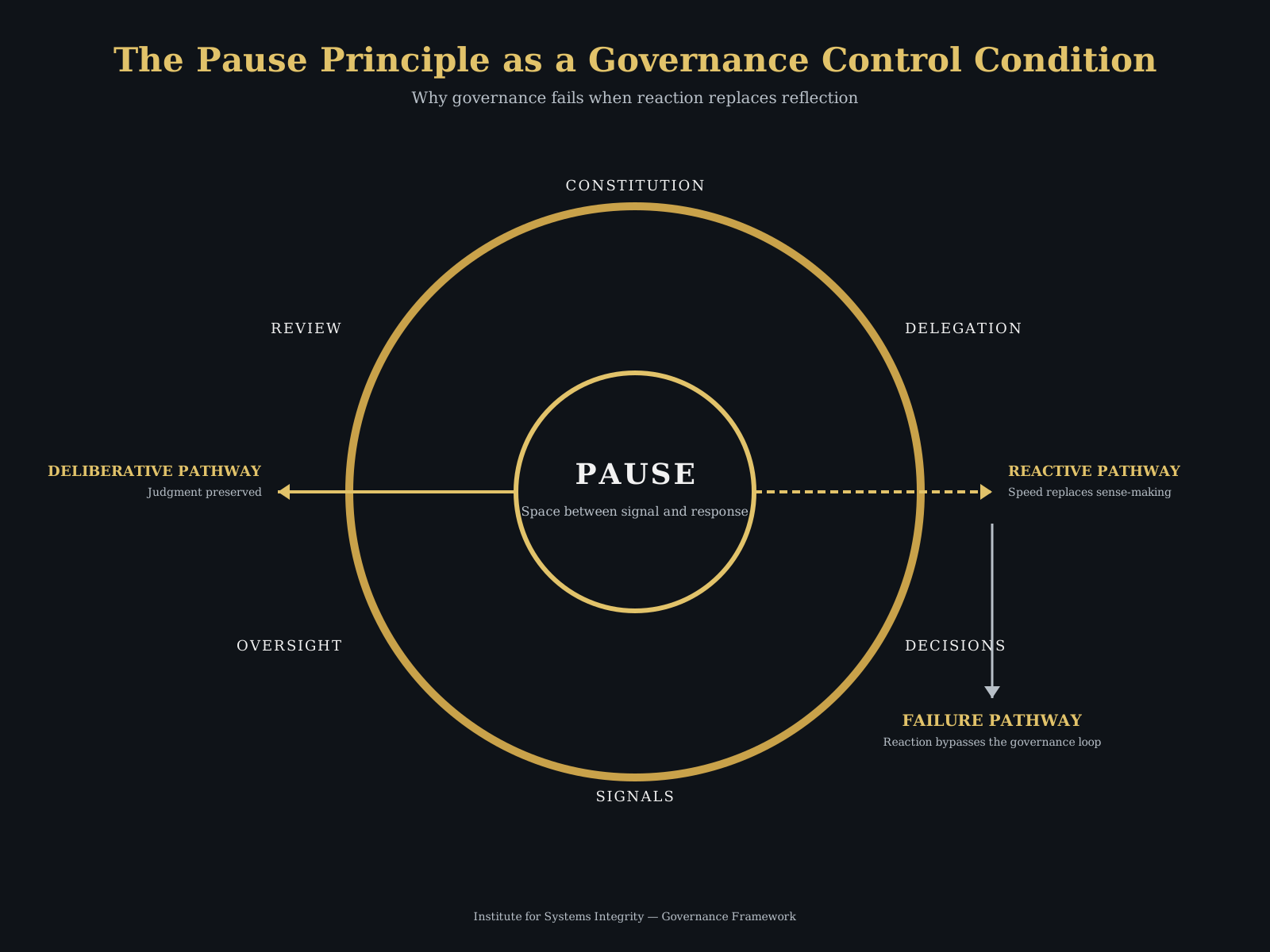
Governance integrity depends on preserved space between signal and response at every stage of the control loop.
This space — the pause — is not discretionary. It is the condition that allows judgment, accountability, and integrity to remain operational under pressure.
The Pause Principle operates as a governance control condition through four elements:
Trigger conditions
Time compression, information overload, escalating stakes, and reputational threat increase decision velocity and narrow cognitive bandwidth.
Control-loop impact
As pressure rises, pause is consumed unevenly across the governance loop: decisions accelerate, signals flatten, and oversight shifts from anticipatory to retrospective.
Failure pathway
When pause is lost, reaction substitutes for judgment. Authority advances faster than accountability, producing the failure sequence described in the Failure Taxonomy — often before harm is visible.
Design safeguards
Pause must be structurally protected through decision gates, escalation protection, temporal buffers, and oversight pacing. These mechanisms preserve optionality and prevent irreversible momentum in the wrong direction.
5. Designing for pause
If pause is a system requirement, it must be deliberately designed.
Effective governance systems embed pause through structure, not personality. Common mechanisms include:
- decision gates separating sensing from deciding
- mandated cooling-off periods for high-impact choices
- protected escalation channels for weak signals
- explicit permission for dissent without penalty
- board agendas prioritising sense-making over reporting
These mechanisms do not slow organisations down.
They prevent irreversible acceleration in the wrong direction.
ISI’s Governance Control Loop framework
(Constitution → Delegation → Decisions → Signals → Oversight → Review)
makes clear that pause is not a break in the loop — it is what keeps the loop closed.
6. Calm as a system property
Popular leadership narratives frame calm as emotional intelligence or personal mastery. While individual regulation matters, this framing is incomplete.
Calm is sustained — or eroded — by system design.
Systems that preserve pause:
- keep judgment online under pressure
- maintain alignment between authority and accountability
- surface risk before it hardens into an outcome
Systems that eliminate pause produce:
- heroic firefighting
- retrospective blame
- ritualised reviews with little learning
The distinction is structural, not moral.
Conclusion
The most consequential governance failures rarely occur in moments of chaos. They occur in moments when reaction feels justified, necessary, even responsible — and no one notices that reflection has quietly exited the system.
The Pause Principle reframes calm as infrastructure.
Where pause disappears, integrity soon follows.
Position within the ISI architecture
This paper:
- extends Integrity Is a System Property
- explains the acceleration dynamics formalised in The Failure Taxonomy
- anchors the Governance Control Loop
- prepares the ground for the Systems Integrity Toolkit — Phase I
It should be read as an architectural bridge between diagnosis and design.
References (Harvard style)
Dekker, S. (2014). The Field Guide to Understanding ‘Human Error’. Farnham: Ashgate.
Reason, J. (1997). Managing the Risks of Organisational Accidents. Aldershot: Ashgate.
Weick, K.E. & Sutcliffe, K.M. (2015). Managing the Unexpected: Sustained Performance in a Complex World. 3rd ed. Hoboken: Wiley.
Hollnagel, E. (2018). Safety-I and Safety-II: The Past and Future of Safety Management. Farnham: Ashgate.
Institute for Systems Integrity (2026). Integrity Is a System Property. ISI.
Institute for Systems Integrity (2026). Decision-Making Under System Stress. ISI.
Institute for Systems Integrity (2026). The Failure Taxonomy. ISI.
© 2026 Institute for Systems Integrity. All rights reserved.
Content may be quoted or referenced with attribution.
Commercial reproduction requires written permission.