
The ISI Governance Control Loop: - How governance maintains integrity — and how failure begins
Governance failure rarely begins with misconduct. It begins when constitutions, delegations, decisions, and oversight drift out of alignment under pressure. The ISI Governance Control Loop explains how integrity fails when the loop stops closing.
Institute for Systems Integrity
Overview
Governance is often described as structures, committees, and compliance processes. At the Institute for Systems Integrity, we treat governance differently: as a control system.
A healthy governance system operates as a closed control loop, in which authority, decisions, accountability, and information remain aligned over time. Integrity is maintained not by rules alone, but by whether this loop continues to function under pressure.
Failure does not begin when rules are broken.
It begins when the loop stops closing.
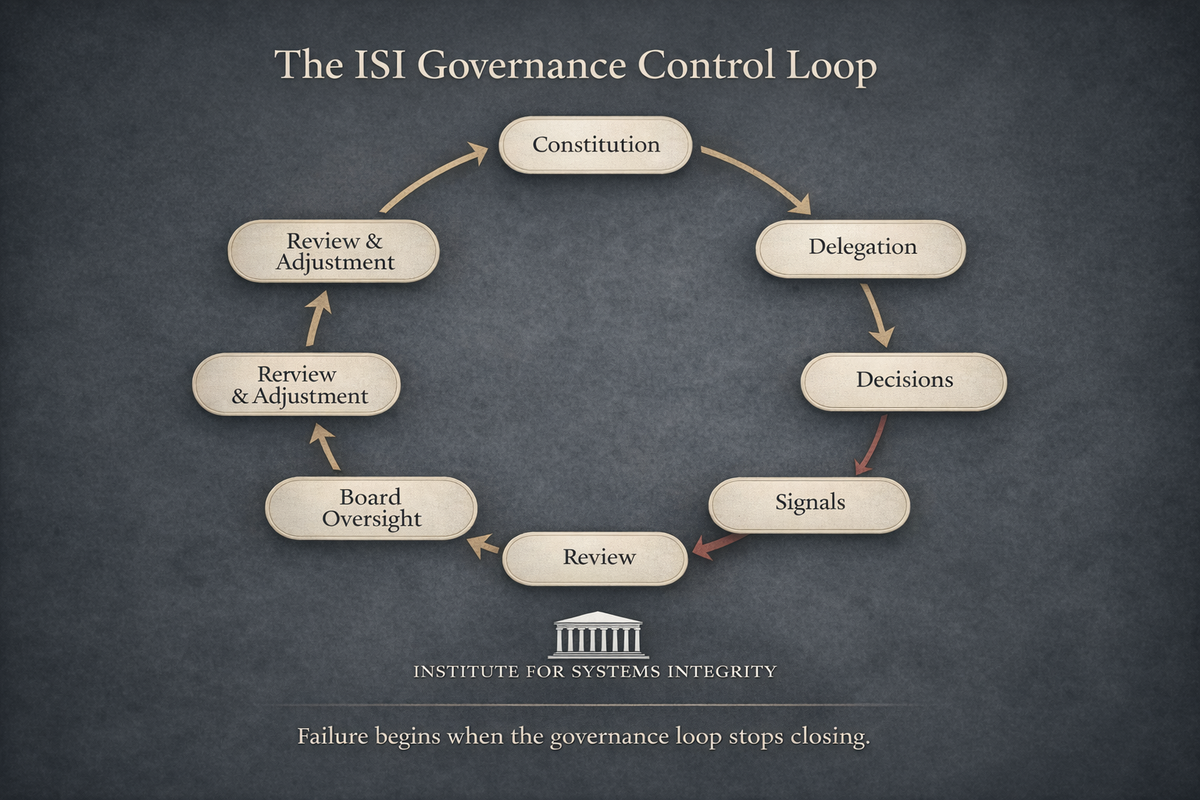
The ISI Governance Control Loop
Constitution
→ Delegation
→ Decisions
→ Signals
→ Board Oversight
→ Review & Adjustment
→ (back to Constitution)
Each stage plays a distinct role. When any stage weakens — especially under sustained system stress — governance may remain formally compliant while becoming practically ineffective.
The stages explained
1. Constitution
The constitution defines purpose, authority, boundaries, and decision rights. It sets the formal architecture of governance.
Failure risk:
Constitutions are static documents operating in dynamic systems. When they are not revisited as complexity and risk increase, they lose relevance without being breached.
2. Delegation
Delegations translate constitutional authority into operational decision rights. They determine who can decide what, under which conditions.
Failure risk:
Delegation creep occurs when authority expands without corresponding evidence, escalation, or review requirements.
3. Decisions
Decisions are made within time, resource, and information constraints. Under pressure, judgment becomes more fragile.
Failure risk:
Speed and throughput override deliberation, while decision quality becomes harder to assess retrospectively.
4. Signals
Signals are the information flows that return to the board: reports, metrics, escalations, and warnings.
Failure risk:
Signals are filtered, delayed, or sanitised. Leading indicators disappear. Assurance replaces insight.
5. Board Oversight
Boards interpret signals, test assumptions, and exercise challenge. Oversight is where governance should correct course.
Failure risk:
Oversight becomes passive when boards rely on completeness of reporting rather than integrity of signals.
6. Review & Adjustment
Effective governance requires periodic review of delegations, structures, and assumptions — especially after stress.
Failure risk:
Reviews occur, but structural settings remain unchanged. The loop no longer resets.
Where governance failure begins
Governance failure does not start with misconduct.
It starts when information stops driving adjustment.
Most commonly, the loop breaks at the Signals → Oversight → Review stages. Boards continue to meet and comply, but no longer see the system as it actually operates.
At that point, compliance increases while control decreases.
How this framework is used at ISI
The ISI Governance Control Loop underpins:
- Integrity Is a System Property — integrity as an outcome of design
- Why Oversight Fails Under Pressure — signal degradation
- When the Constitution Becomes a Weapon — structural lock-in
- The Failure Taxonomy — predictable breakdown patterns
- The Systems Integrity Toolkit — diagnostic application (to follow)
This framework provides the backbone for diagnosing governance failure before harm occurs.
Key ISI insight
If integrity is a system property, governance is the control loop that maintains it.
Failure begins when the loop stops closing.
© 2026 Institute for Systems Integrity. All rights reserved.
Content may be quoted or referenced with attribution.
Commercial reproduction requires written permission.