
The Failure Taxonomy
A derived governance framework showing how drift, signal loss, and accountability inversion produce harmful outcomes in stressed systems.
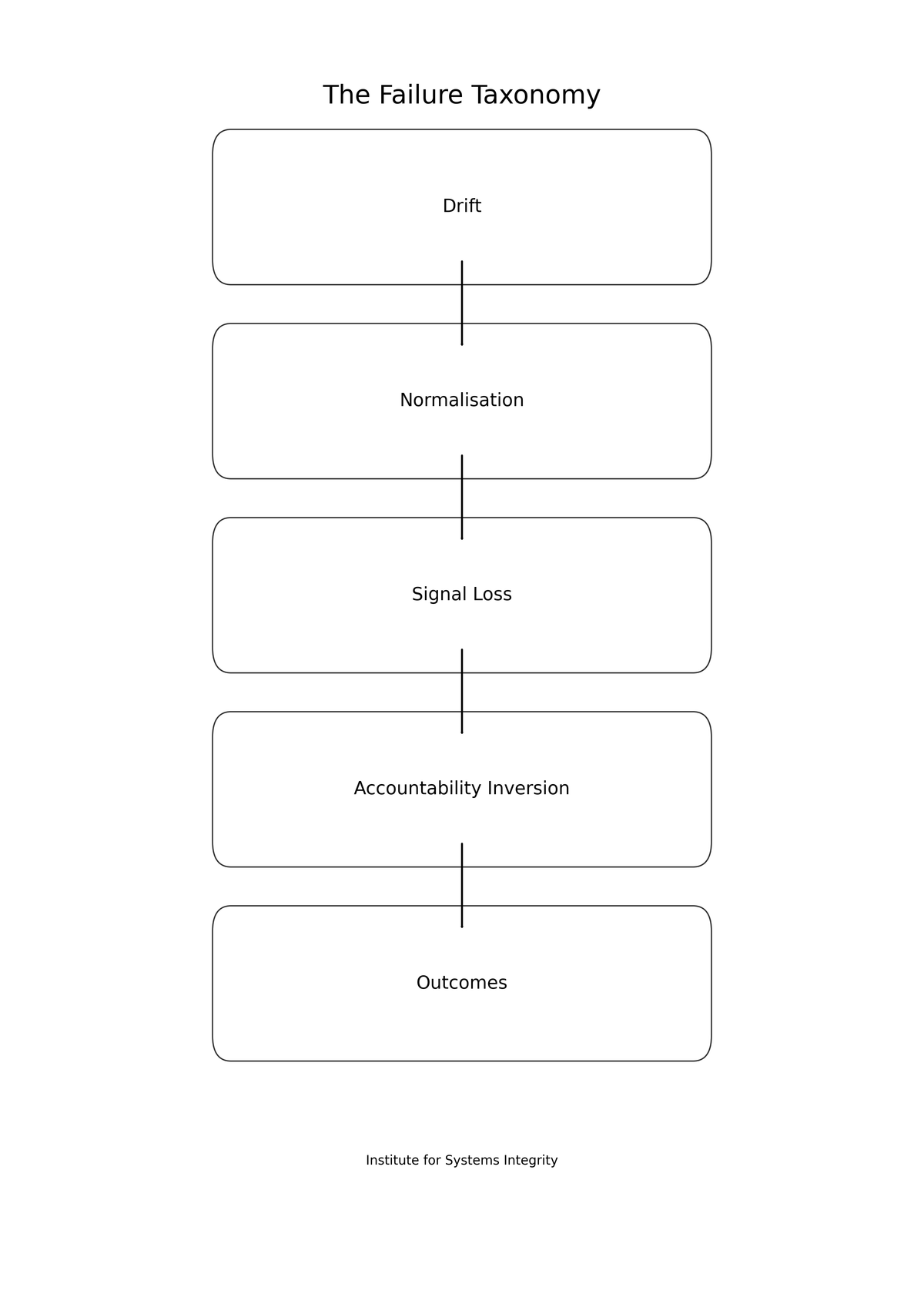
A derived framework from the Systems Integrity Cascade
Institute for Systems Integrity (ISI)
What this framework is
The Failure Taxonomy explains how harm accumulates inside complex systems without anyone intending it.
It shows why disasters rarely require:
- bad people
- corruption
- negligence
and instead emerge through predictable structural pathways when systems operate under sustained pressure.
This framework is derived from the Systems Integrity Cascade and forms one of ISI’s four Phase I diagnostic lenses.
The Failure Taxonomy
Drift → Normalisation → Signal Loss → Accountability Inversion → Outcomes
This is not a moral sequence.
It is a system sequence.
The Failure Taxonomy is a core framework of the Institute for Systems Integrity.
It describes how harm emerges in complex systems without malice, incompetence, or unethical intent.
The framework explains why failures so often appear “unexpected” — and why inquiries that focus on individual behaviour routinely miss the true source of harm.
The Five Failure Stages
Drift
Small deviations from designed practice accumulate quietly as systems adapt to demand.
Workarounds emerge so people can continue functioning under pressure.
Over time, the system’s actual operating mode diverges from what policies, procedures, and oversight assume.
This is the same adaptive dynamic described in Decision-Making Under System Stress.
Normalisation
Workarounds become routine.
Risk becomes invisible.
What was once exceptional becomes “how things are done”.
This is the normalisation of deviance — the point at which drift becomes cultural rather than procedural.
Signal Loss
As drift becomes normal, warning signals disappear.
Near-misses go unreported.
Dashboards flatten reality.
Escalation weakens.
Oversight remains formally intact, but no longer reflects operational truth — the pattern analysed in Why Oversight Fails Under Pressure.
Accountability Inversion
When outcomes deteriorate, responsibility flows downward while authority remains insulated.
Frontline actors absorb blame for conditions they did not create.
Structural causes remain untouched.
This reflects misalignment between authority, accountability, and information, formalised in Integrity as a System Property.
Outcomes
By the time harm becomes visible, the pathway that produced it is already deeply embedded.
Investigations, disciplinary action, and new rules arrive after damage has occurred.
They respond to symptoms, not to the structural sequence that made harm inevitable.
Position in the ISI Architecture
The Failure Taxonomy is a derived view of the Systems Integrity Cascade.
Where the Cascade describes:
- System conditions
- Decision integrity
- Governance mediation
- Failure dynamics
- Outcomes
The Failure Taxonomy shows how those dynamics translate into harm over time once drift and oversight blindness take hold.
Together, they form a single coherent diagnostic system for understanding failure under sustained pressure.
Where This Framework Is Used
This taxonomy underpins:
- The Failure Taxonomy
- Decision-Making Under System Stress
- Why Oversight Fails Under Pressure
- Integrity Is a System Property
It also informs the companion paper:
- When Resilience Appears, Governance Has Already Failed,
which examines how frontline heroics and adaptive sacrifice emerge once accountability inversion and structural failure are already present.
The Failure Taxonomy forms part of the Systems Integrity Phase I Toolkit (forthcoming).
Why This Framework Exists
Most governance systems are designed to detect misconduct.
The Failure Taxonomy is designed to detect structural danger — long before anyone breaks a rule.
That is the difference between prevention and inquiry.
Citation
Institute for Systems Integrity (2026).
The Failure Taxonomy: How Harm Emerges Without Malice.
Derived from the Systems Integrity Cascade.
https://www.systemsintegrity.org
© 2026 Institute for Systems Integrity. All rights reserved.
Content may be quoted or referenced with attribution.
Commercial reproduction requires written permission.