Toolkit Framework#1 - Integrity Protection Stack (IPS)
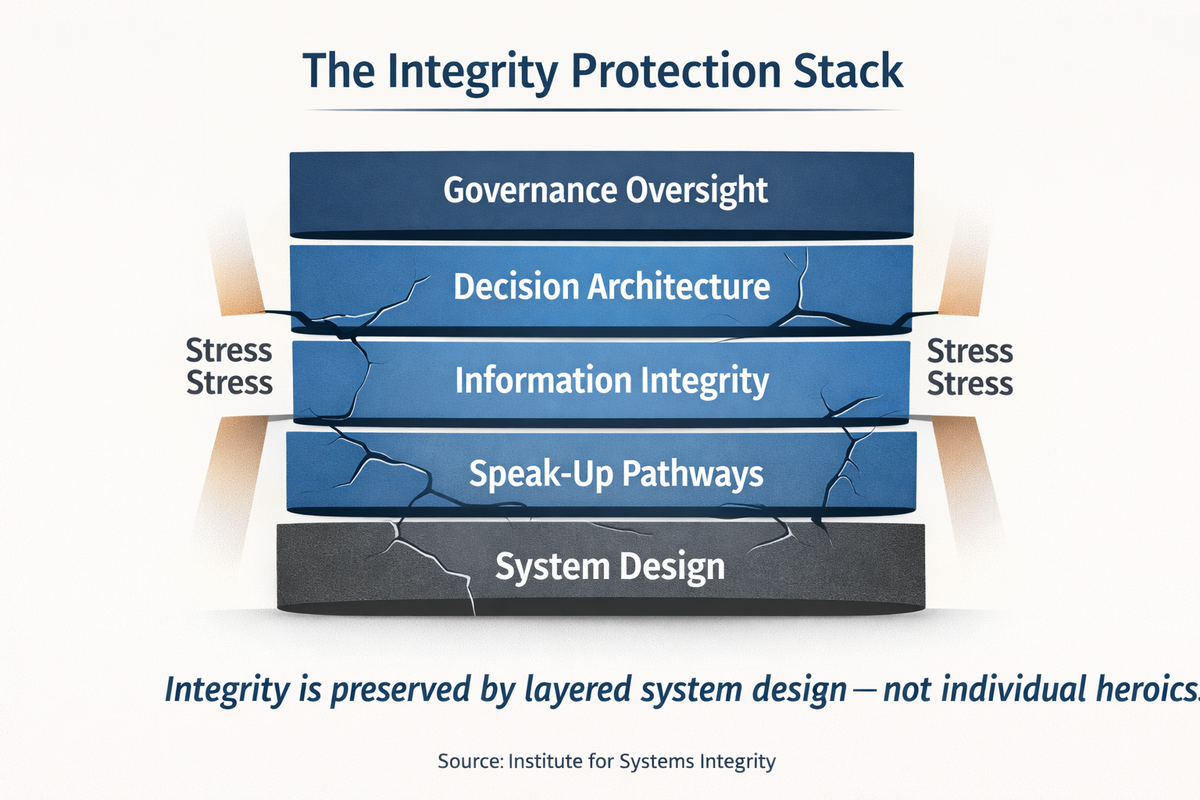
The Integrity Protection Stack (IPS) explains how integrity is preserved under system stress through layered system design rather than individual resilience or heroics.
Institute for Systems Integrity
The Integrity Protection Stack (IPS)
Subhead: A layered governance architecture for preserving integrity under system stress
Definition (canonical)
The Integrity Protection Stack is a layered governance architecture that preserves integrity under system stress by ensuring multiple protective system layers remain intact when individual judgment is constrained.
The five layers (fixed order)
- System Design — resourcing, incentives, workflows, constraints, risk distribution
- Decision Architecture — how decisions are framed, timed, escalated, bounded, reviewed
- Information Integrity — accuracy, completeness, timeliness, representativeness of signals
- Speak-Up Pathways — safe escalation, dissent, early warnings, response credibility
- Governance Oversight — visibility, authority, corrective power under stress
How to use
Use IPS to diagnose where integrity is being “carried by people” rather than protected by design—especially when resilience, workarounds, and informal coping are sustaining outcomes.
What this is not
Not a culture model. Not an ethics checklist. Not a post-incident blame tool.
Relationship to ISI frameworks
IPS operationalises the Cascade’s emphasis on upstream conditions and governance mediation:
Applied in
- Foundation Article # 1: Decision-Making Under System Stress
- Foundation Article # 2: Why Oversight Fails Under Pressure
Citation
Institute for Systems Integrity (2026). The Integrity Protection Stack (IPS). systemsintegrity.org.