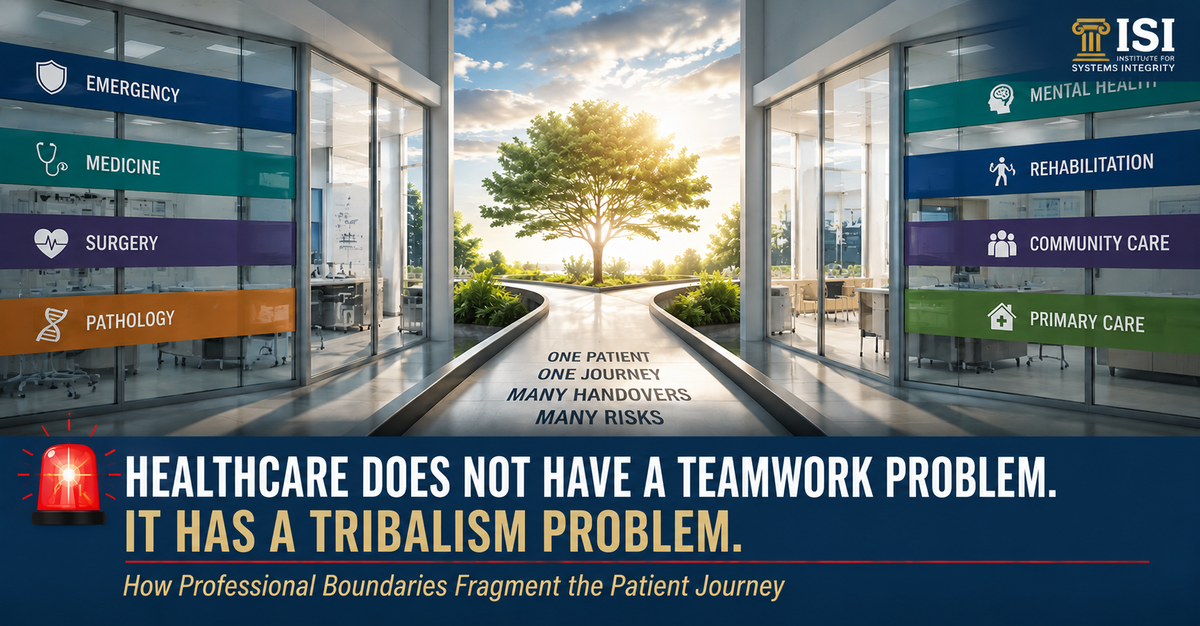
HEALTHCARE DOES NOT HAVE A TEAMWORK PROBLEM.: IT HAS A TRIBALISM PROBLEM.: How Professional Boundaries Fragment the Patient Journey
Healthcare has invested heavily in teamwork, yet patients still experience fragmented care. This paper argues the deeper problem is professional tribalism and introduces governance frameworks to help boards protect the patient journey across organisational boundaries.
Dr Alwin Tan, GAICD, MBBS, FRACS, EMBA (Melbourne Business School)
Senior Surgeon | Governance Leader | HealthTech Co-founder | Founder of Institute for Systems Integrity (ISI) |Harvard Medical School — AI in Healthcare| University of Oxford — Sustainable Enterprise | Bastas Academy for Healthcare Leadership - Triple Scholar
Nadra Gadeed BSc Psychology, MSc Forensic Psychology, MA Health Research
Founder and Strategic Advisor of Edify & Grow, a workforce risk advisory practice for boards and C-suite leaders in private healthcare across the GCC and Asia-Pacific. | NHS senior leadership experience spanning strategic, operational and clinical leadership. - 20 years experience - Combining expertise in Psychology, Forensic Psychology and Health Research |
Institute for Systems Integrity
THE PATIENT IS THE ONLY PERSON REQUIRED TO CROSS EVERY BOUNDARY IN HEALTHCARE.
YET ALMOST NO ONE GOVERNS WHAT HAPPENS BETWEEN THEM.
Executive Summary
Healthcare has invested heavily in teamwork.
Multidisciplinary meetings.
Handover tools.
Communication frameworks.
Leadership programs.
Interprofessional education.
Escalation policies.
All are valuable.
Yet patients continue to experience fragmentation.
Information is lost between services.
Responsibility becomes unclear during transitions.
Different teams develop competing plans.
Patients repeatedly explain the same history.
Follow-up fails between organisations.
Each part of the system may perform its role correctly while the patient journey still breaks down.
The problem may be deeper than teamwork.
Healthcare is structurally organised into professional, specialty, departmental and institutional tribes.
These tribes create expertise, identity, standards and belonging. They are necessary.
The risk arises when the boundaries that preserve expertise also prevent information, responsibility and judgement from moving reliably across the system.
This paper argues that healthcare tribalism should not be understood primarily as an interpersonal or cultural failure.
It is a systems architecture and governance problem.
The Institute for Systems Integrity proposes the Healthcare Tribal Integrity Framework™, describing how professional identity can generate boundaries, boundary assumptions and information filtering before producing fragmented care and patient harm.
The central proposition is:
TRIBALISM BECOMES A GOVERNANCE FAILURE WHEN THE SYSTEM PROTECTS THE BOUNDARY BETTER THAN IT PROTECTS THE PATIENT JOURNEY.
1. The Teamwork Diagnosis Is Incomplete
When care fails between professionals or departments, healthcare often concludes that communication was poor.
The response is familiar.
More training.
Clearer protocols.
Better meetings.
More structured handovers.
Another escalation pathway.
These interventions may improve performance.
But they frequently leave the underlying system untouched.
Healthcare professionals are still:
Educated separately.
Credentialled separately.
Regulated separately.
Managed separately.
Measured separately.
Budgeted separately.
And organised into departments responsible primarily for their own part of care.
Healthcare then asks individuals to collaborate across boundaries the system itself has created.
That is not merely a teamwork problem.
It is a design problem.
Professional cultures contain distinct language, values, practices, beliefs and assumptions about knowledge and responsibility. These differences contribute to expertise, but they can also impede collaboration when professional boundaries become rigid (Hall, 2005).
Clinical tribalism has similarly been associated with hierarchy, professional stereotyping and barriers between groups. Importantly, these behaviours are strongly influenced by workplace context and organisational design rather than being fixed features of individual professions (Braithwaite et al., 2016).
That distinction matters.
If tribalism is created or reinforced by the system, then it can be governed.
WE CANNOT ORGANISE HEALTHCARE AROUND SEPARATION—
THEN BLAME INDIVIDUALS WHEN INTEGRATION FAILS.
2. What Is a Healthcare Tribe?
A tribe is a group whose members share identity, language, knowledge, practices, experiences and assumptions about how work should be performed.
Healthcare contains many overlapping tribes.
Professional tribes
· Medicine
· Nursing
· Allied health
· Pharmacy
· Administration
· Management
· Governance
Specialty tribes
· Surgery
· Internal medicine
· Emergency medicine
· Anaesthesia
· Intensive care
· Psychiatry
· General practice
· Radiology
· Pathology
Institutional tribes
· Primary care
· Public hospitals
· Private hospitals
· Community health
· Universities
· Regulators
· Professional colleges
· Government agencies
Geographic tribes
· Metropolitan
· Regional
· Rural
· Remote
Each tribe contributes something essential.
A shared identity helps create standards.
Specialty language supports precision.
Professional culture strengthens belonging and expertise.
The problem is not the existence of tribes.
The problem emerges when the boundary surrounding the tribe becomes difficult for information, responsibility or judgement to cross.
Operational experience of leading partnership work across health, local authority and voluntary sector organisations points to a fifth tribal boundary that rarely appears in healthcare frameworks: the boundary between statutory and voluntary provision, echoing the broader duty-of-care and professional-identity tensions between silos described elsewhere in the literature (Bakewell, 2025).
This is not only a language problem: it is a power and funding asymmetry.
Cross-sector budget management shows that the sharpest boundary failures are often not clinical at all; they occur between organisations on different funding cycles and reporting lines, where the better-resourced statutory partner tends to set the terms of collaboration, itself a governance failure rather than a fixed feature of the relationship.
3. Tribalism Is Not the Same as Specialisation
Healthcare depends upon specialisation.
No individual can possess all the knowledge required to diagnose, treat and coordinate increasingly complex care.
Specialisation creates depth.
Tribalism determines what happens at the boundary of that depth.
Specialisation says:
This is what we know.
Tribalism says:
This is where our responsibility ends.
Specialisation creates expertise.
Tribalism can create separation.
Specialisation clarifies roles.
Tribalism can make transitions ambiguous.
Specialisation contributes knowledge to the whole.
Tribalism may keep that knowledge inside the part.
The governance challenge is not to weaken professional identity.
It is to ensure that expertise remains connected to the wider patient journey.
Forensic psychology draws on well-established work showing that ‘this is where our responsibility ends’ is rarely a conscious act of neglect.
It is a boundary-protection response: the mechanism that allows professionals in ethically demanding institutional roles to rationalise responsibility-limiting decisions, and to absorb daily exposure to risk, blame and uncertainty without being overwhelmed by it (Neal, 2017).
Osofsky, Bandura and Zimbardo (2005) offer the clearest empirical demonstration of this mechanism in a professional setting.
This is not an argument for removing individual accountability, only for locating it correctly: the boundary that protects the professional is the same boundary that can leave the patient exposed, and a governance response that treats this as purely a discipline problem, or purely a systems problem, will fail either way (Bakewell, 2025).
EXPERTISE SHOULD STRENGTHEN THE PATIENT JOURNEY.
IT SHOULD NEVER BECOME A BORDER THE PATIENT MUST SURVIVE.
4. The Patient Experiences One Journey
Patients do not experience healthcare through organisational charts.
They experience a journey.
A patient may move from:
General practice.
To diagnostic imaging.
To specialist consultation.
To hospital admission.
To surgery.
To recovery.
To the ward.
To rehabilitation.
To community care.
To another organisation.
At every transition, something essential must survive.
Clinical information.
Diagnostic reasoning.
Medication history.
Patient preferences.
Known risks.
Responsibility.
Escalation thresholds.
Follow-up plans.
The patient experiences the accumulated performance of all these interfaces.
But each team may remain accountable only for its own stage.
This creates a structural contradiction.
The patient journey is horizontal.
Healthcare governance is predominantly vertical.
Departments report upward.
Professions regulate inward.
Performance measures assess discrete services.
Budgets sit within organisational units.
Yet patient risk travels across all of them.
PATIENTS EXPERIENCE HORIZONTAL CARE IN SYSTEMS GOVERNED VERTICALLY.
A department can meet its performance targets while the overall patient journey remains unsafe.
A hospital can complete a discharge while the receiving service lacks critical information.
A procedure can be technically successful while continuity of care fails.
Every component may appear to perform adequately.
The system can still fail at the interface.
5. Interfaces Are Where Systems Become Vulnerable
The highest-risk points in healthcare are often not inside departments.
They are between them.
Between professions.
Between shifts.
Between wards.
Between diagnostic and treating teams.
Between hospital and community.
Between clinicians and administrators.
Between one institution and another.
Interfaces are where:
Information changes hands.
Responsibility is transferred.
Assumptions remain untested.
Uncertainty becomes compressed.
Tasks become separated from their original reasoning.
And no single person may retain sight of the whole journey.
Most governance systems are designed around organisational units.
Incidents are reviewed by departments.
Performance is measured within services.
Accountability follows reporting lines.
But many patient harms emerge from failures spanning several units.
No single department may appear to have failed.
The interface did.
THE MOST DANGEROUS PART OF A HEALTHCARE SYSTEM MAY BE THE SPACE BETWEEN TWO TEAMS THAT ARE EACH PERFORMING WELL.
6. Why Information Dies at Boundaries
Healthcare frequently assumes that information has been communicated because it was documented, handed over or discussed.
But transmission is not the same as survival.
Information can cross a boundary and still lose meaning.
A concern may be shortened.
A clinical nuance may disappear.
A provisional diagnosis may become recorded as fact.
A risk may be documented without its urgency.
A patient preference may become secondary to workflow.
A rationale may be separated from the decision it originally supported.
The question is therefore not merely:
Was the information sent?
It is:
Did the receiving team understand its significance well enough to act appropriately?
This distinction is central to Information Fidelity.
Information Fidelity describes the extent to which meaning remains accurate, complete and actionable as information moves through a system.
A handover can be technically complete while clinically inadequate.
A discharge summary can contain facts while omitting the reasoning required for safe follow-up.
A referral can reach the correct service while failing to communicate urgency.
A risk can appear on a dashboard after its operational meaning has been diluted.
A SIGNAL HAS NOT SURVIVED MERELY BECAUSE IT REACHED THE NEXT TEAM.
IT HAS SURVIVED ONLY IF ITS MEANING REMAINED INTACT.
This pattern is well recognised in safeguarding practice, even if the evidence base here is practice-derived rather than peer-reviewed.
A concern is rarely rejected outright at the next boundary: it is diluted, moving from a specific, urgent observation to a generalised note, then a line in a report, then an agenda item.
No one individual weakens the signal; the system does it gradually, at every crossing. This pattern recurs across UK safeguarding practice guidance and case-review learning, not as an isolated impression (NSPCC Learning, 2023; Department for Education, 2023).
7. The Translation Problem
Every healthcare tribe develops its own language.
This supports precision within the group.
But the same language can create distortion across boundaries.
Clinical language may be translated into operational language.
Operational language into executive language.
Executive language into board reporting.
With each translation, complexity is compressed.
A concern may begin as:
“This patient is clinically unsafe to discharge.”
It becomes:
“There are concerns regarding discharge readiness.”
Then:
“The discharge pathway requires review.”
Finally:
“A process improvement initiative is underway.”
The words have travelled.
The danger has not.
This is not necessarily deliberate.
Every part of the system translates information into the language it knows how to process.
But when translation repeatedly reduces urgency, uncertainty or consequence, governance becomes disconnected from frontline reality.
The challenge is not simply better communication.
It is preserving meaning across different forms of professional and organisational language.
This cascade is often experienced from both sides: as the person raising the original concern, and later as the person receiving its diluted version several layers up.
What stands out is rarely dishonesty at any single step; each translation is typically a reasonable summary of what came before it.
The distortion is cumulative, not deliberate. It is a pattern borne out empirically in handover research, where clinicians recall significantly corrupted information compared with the medical record with no single step of dishonesty involved (Pickering, Hurley and Marsh, 2009).
This is exactly why it cannot be solved by disciplining whoever happened to be holding it when it broke.
8. The Healthcare Tribal Integrity Framework™
The Institute for Systems Integrity proposes the Healthcare Tribal Integrity Framework™ to describe how necessary professional identity can become a systems risk.
Stage 1: Professional Identity
Individuals develop expertise, belonging and standards through profession, specialty, department and institution.
Identity strengthens competence and cohesion.
Stage 2: Boundary Formation
The system separates roles, knowledge, responsibility, authority and workflow.
Boundaries create order.
Stage 3: Boundary Assumptions
Each group develops assumptions about:
· what it owns;
· what it does not own;
· what others should know;
· what others should do;
· and where its responsibility ends.
Stage 4: Information Filtering
Information crossing the boundary is translated through the language, priorities and workflow of the receiving group.
Some meaning is preserved.
Some is reduced.
Some is lost.
Stage 5: Responsibility Diffusion
More than one team becomes involved, but no one retains clear stewardship of the whole journey.
Tasks are allocated.
Journey ownership is not.
Stage 6: Interface Failure
Critical information, reasoning or responsibility fails to transfer reliably.
Stage 7: Fragmentation
The patient experiences disconnected plans, repeated assessments, delayed escalation, contradictory advice or gaps in follow-up.
Stage 8: Integrity Failure
The system can no longer maintain alignment between:
· what is known;
· what is communicated;
· what is understood;
· what is decided;
· what is done;
· and what the patient experiences.
Stage 9: Patient Harm
Risk emerges through:
· delayed diagnosis;
· incomplete handover;
· treatment discontinuity;
· duplicated care;
· medication error;
· missed follow-up;
· contradictory plans;
· and responsibility gaps.
The framework can be expressed as:
Identity
↓
Boundary
↓
Boundary assumptions
↓
Information filtering
↓
Responsibility diffusion
↓
Interface failure
↓
Fragmentation
↓
Integrity failure
↓
Patient harm
The problem does not begin when individuals stop caring.
It begins when the system assumes that good intentions are sufficient to bridge poorly governed boundaries.
9. The Journey Ownership Gap™
Many healthcare systems assign responsibility for tasks.
Few assign responsibility for the integrity of the whole patient journey.
One team orders the test.
Another interprets it.
Another communicates the result.
Another arranges treatment.
Another plans discharge.
Another provides follow-up.
Each task has an owner.
The journey may not.
This creates the Journey Ownership Gap™.
The Journey Ownership Gap™ is the space between distributed task responsibility and whole-of-journey stewardship.
It appears when:
· every team performs its assigned role;
· no team sees itself as responsible for the combined outcome;
· unresolved issues sit between services;
· and the patient becomes the only person connecting the parts.
Patients and families then become unofficial system integrators.
They carry information.
Correct misunderstandings.
Repeat their history.
Identify missing follow-up.
Ask which team is responsible.
And attempt to reconcile conflicting advice.
WHEN THE PATIENT BECOMES THE PRIMARY COORDINATOR OF A COMPLEX HEALTHCARE JOURNEY, THE SYSTEM HAS TRANSFERRED ITS INTEGRATION FAILURE TO THE PERSON LEAST EQUIPPED TO CARRY IT.
This gap doesn’t only cost patients; it costs the workforce.
When no one owns the journey, someone still absorbs the coordination work that was never designed into their role, and recent research links exactly this kind of uncoordinated clerical and coordination burden to clinician burnout (Funk et al., 2024).
It isn’t evenly distributed either: informal coordination work that goes unrecognised tends to track professional hierarchy, with nursing and allied health absorbing more of it than medicine (Essex et al., 2023).
That is also why ‘govern every interface equally’ is a flawed instruction to give a board; boards should prioritise the interfaces where this invisible load is heaviest, not attempt all of them at once.
This is measurable, not just anecdotal; frameworks that track leadership clarity and stability alongside attrition and burnout, including the Workforce Risk Index™, a diagnostic framework developed by one of this paper’s co-authors, treat these as connected signals rather than separate metrics, because leadership instability is usually what determines whether an unowned interface is quietly absorbed by staff for a while, or starts showing up in the exit data.
10. Multidisciplinary Care Is Not Necessarily Integrated Care
Healthcare often treats multidisciplinary participation as evidence of integration.
But the presence of multiple professions does not guarantee that their knowledge becomes combined into a coherent decision.
A multidisciplinary meeting may include every relevant profession while:
· information remains incomplete;
· decision rights remain unclear;
· concerns are noted but not resolved;
· one team assumes another will follow up;
· and no one owns the outcome across settings.
Attendance is not integration.
Discussion is not coordination.
Documentation is not stewardship.
True integration requires:
· shared understanding of the patient’s goals;
· clarity about who decides;
· clarity about who acts;
· clarity about who follows up;
· explicit transfer of responsibility;
· and confirmation that the receiving team has accepted that responsibility.
The question is not:
Was every profession represented?
It is:
Did the system convert their combined knowledge into one coherent patient journey?
11. Boundary Governance
Healthcare governance has traditionally focused on structures.
Departments.
Committees.
Professional groups.
Reporting lines.
But fragmented care requires governance of the spaces between those structures.
Boundary governance asks:
· What critical information must cross this interface?
· Who is responsible for sending it?
· Who confirms it has been received and understood?
· When does responsibility formally transfer?
· Who acts when the receiving team disagrees?
· Who maintains oversight when care spans several services?
· Who reviews failures that involve more than one department?
· Who represents the patient’s perspective across the whole journey?
Boundary governance does not remove local accountability.
It connects local accountability to system performance.
Without it, departments may become highly reliable internally while the patient journey remains unreliable externally.
One accountability question boards rarely ask is who is accountable when an interface failure shows up as burnout rather than as a patient incident.
Both are downstream of the same ungoverned boundary, but only one of them triggers an incident report.
Burnout is conventionally treated as workforce or HR territory rather than integrated into board-level risk governance, even though it is increasingly recognised as a systems issue with direct implications for patient safety and organisational durability (National Academies of Sciences, Engineering, and Medicine, 2019).
It speaks directly to executive sustainability and leadership clarity, the same signals that determine whether an organisation can retain the workforce needed to keep its interfaces staffed at all.
12. Critical Integrity Interfaces™
The Institute for Systems Integrity proposes that healthcare organisations identify and govern their Critical Integrity Interfaces™.
A Critical Integrity Interface™ is a transition at which failure of information, judgement or responsibility could materially affect patient care.
Examples include:
· emergency department to inpatient ward;
· operating theatre to recovery;
· recovery to ward;
· intensive care to general ward;
· hospital to primary care;
· diagnostic service to treating clinician;
· specialist to specialist;
· public to private care;
· paediatric to adult services;
· acute care to rehabilitation;
· and clinical governance to board oversight.
For each interface, five forms of ownership should be explicit.
1. Signal ownership
Who ensures that critical information crosses the boundary?
2. Meaning ownership
Who ensures that the significance of the information is preserved?
3. Decision ownership
Who has authority when teams disagree?
4. Journey ownership
Who retains responsibility for continuity from the patient’s perspective?
5. Learning ownership
Who examines repeated failures spanning more than one service?
When these responsibilities are unclear, the patient journey depends upon individual goodwill, memory and informal relationships.
That is not reliable integration.
It is organisational improvisation.
13. Governing Information Fidelity
Boards do not need to review every handover.
But they should know whether critical information survives across the organisation.
Useful questions include:
· Where are patients required to repeat their histories?
· Which transitions generate recurrent complaints or incidents?
· How often are tests repeated because previous results are unavailable?
· How often is follow-up delayed because responsibility is unclear?
· Which services report incomplete referrals?
· Where do clinical concerns lose urgency as they move upward?
· How often does the receiving team reject or misunderstand a transfer?
· Are interface failures reviewed jointly or separately by each department?
· Can the organisation track a safety signal from frontline observation to executive action?
· Does the board receive information about cross-boundary risk or only departmental performance?
How much unpaid coordination work is the workforce absorbing to compensate for ungoverned interfaces, and is it visible anywhere in attrition or burnout data?
A board may receive assurance that every department is meeting its objectives.
That assurance does not prove the patient journey is intact.
LOCAL PERFORMANCE IS NOT THE SAME AS SYSTEM INTEGRITY.
14. From Handover to Stewardship
Handover is commonly treated as an event.
A conversation.
A document.
A referral.
A transfer.
But continuity of care requires more than information exchange.
It requires stewardship.
Stewardship means maintaining responsibility for the integrity of the journey until another party has clearly accepted it.
This changes the question from:
Did we send the information?
To:
Did the next part of the system receive, understand and act upon it?
It changes discharge from an endpoint into a transfer of stewardship.
It changes referral from an administrative transaction into a continuity obligation.
It changes escalation from speaking into ensuring the signal produces an appropriate response.
It changes multidisciplinary care from shared attendance into shared accountability for the whole.
15. The Higher Organising Principle
Healthcare will never eliminate professional tribes.
Nor should it.
Professional identity builds expertise.
Specialty identity creates depth.
Team identity supports trust.
Institutional identity can inspire service.
The solution is not to remove these identities.
It is to establish a higher organising principle capable of connecting them.
That principle is stewardship of the patient journey.
Not ownership of the patient.
Not control of the service.
Not protection of the department.
Stewardship.
Stewardship asks each part of the system to contribute its expertise while remaining responsible for how that expertise connects with the next part.
It recognises that safe care is not produced only by excellent components.
It is produced by the integrity of the relationships between them.
THE STRONGEST HEALTHCARE SYSTEM WILL NOT BE THE ONE WITH THE WEAKEST PROFESSIONAL IDENTITIES.
IT WILL BE THE ONE WITH A PURPOSE STRONG ENOUGH TO CONNECT THEM.
Stewardship of the patient journey requires something the framework doesn’t yet name directly: psychological safety at the boundary.
A clinician will only flag a concern outside their own remit, or accept responsibility for a journey they don’t fully control, in a culture where doing so is safe (Nembhard and Edmondson, 2006).
That safety isn’t distributed equally: hierarchy remains one of the most consistent barriers to speaking up across professions; qualitative work in one interprofessional obstetrics and gynaecology department found it persisted even in a team with a genuinely shared vision for collaboration, suggesting shared vision alone may not be sufficient to close the gap (Malik et al., 2024).
Stewardship is a behaviour. It only survives in a culture that rewards it evenly.
Questions for Boards and Executives
Boards and executives should ask:
1. Which patient journeys cross the greatest number of organisational boundaries?
2. Where does responsibility become ambiguous?
3. Which transitions produce repeated incidents, complaints or delays?
4. Who owns risk spanning several departments?
5. Can critical information be tracked across the entire journey?
6. Where is meaning lost through organisational translation?
7. Are departments rewarded for local performance or shared outcomes?
8. Do multidisciplinary processes produce integrated decisions?
9. Are patients and families carrying coordination responsibilities the system should own?
10. Who governs the interfaces?
11. Is workforce risk, including attrition and burnout linked to unowned interfaces, tracked with the same rigour as clinical risk?
These questions shift governance from isolated organisational units towards whole-of-journey integrity.
Conclusion
Healthcare does not merely have a teamwork problem.
It has a structural problem.
Professional identity, specialisation and organisational boundaries create enormous value.
But they also divide information, responsibility and judgement across a patient journey that remains indivisible.
Patients experience one journey.
Healthcare delivers many parts.
The greatest risks often arise not because one part lacks expertise, but because the connections between the parts are weak, ambiguous or ungoverned.
The answer is not another appeal for people to communicate better.
It is governance capable of ensuring that:
· information survives transition;
· meaning remains intact;
· responsibility transfers clearly;
· interfaces are explicitly owned;
· departments are connected through shared outcomes;
· and someone retains stewardship of the whole patient journey.
Healthcare needs strong professions.
Strong specialties.
Strong departments.
Strong institutions.
But strength within the parts is not enough.
The system must also possess integrity between them.
THE PATIENT SHOULD NEVER HAVE TO HOLD THE HEALTHCARE SYSTEM TOGETHER.
THAT IS THE SYSTEM’S RESPONSIBILITY.
Nor should the workforce silently absorb what the system fails to own. The same governance that protects the patient journey protects the people delivering it.
References
Bakewell, F. (2025) ‘Medical silos, social identity, and duty of care: A call for health leaders to improve transitions of care’, Healthcare Management Forum, 38(2), pp. 148–151.
Braithwaite, J., Clay-Williams, R., Vecellio, E., Marks, D., Hooper, T., Westbrook, M., Westbrook, J., Blakely, B. and Ludlow, K. (2016) ‘The basis of clinical tribalism, hierarchy and stereotyping: A laboratory-controlled teamwork experiment’, BMJ Open, 6(7), e012467.
Department for Education (2023) Improving Multi-Agency Information Sharing. London: Department for Education.
Essex, R. et al. (2023) ‘A scoping review exploring the impact and negotiation of hierarchy in healthcare organisations’, Nursing Inquiry, 30(4), e12571.
Funk, K.A., Stillman, M., Wang, Q., Turcotte Manser, S. and Rogers, E.A. (2024) ‘Association of burnout with primary care clinician perception of team-based scheduling support’, Journal of Primary Care & Community Health, 15.
Hall, P. (2005) ‘Interprofessional teamwork: Professional cultures as barriers’, Journal of Interprofessional Care, 19(Suppl. 1), pp. 188–196.
Hollnagel, E., Wears, R.L. and Braithwaite, J. (2015) From Safety-I to Safety-II: A White Paper. Middelfart: University of Southern Denmark, University of Florida and Macquarie University.
Malik, R.F. et al. (2024) ‘How do cultural elements shape speak-up behavior beyond the patient safety context? An interprofessional perspective in an obstetrics and gynecology department’, Frontiers in Medicine, 11, 1345316.
Manser, T. (2009) ‘Teamwork and patient safety in dynamic domains of healthcare: A review of the literature’, Acta Anaesthesiologica Scandinavica, 53(2), pp. 143–151.
Meadows, D.H. (2008) Thinking in Systems: A Primer. White River Junction, VT: Chelsea Green Publishing.
National Academies of Sciences, Engineering, and Medicine (2019) Taking Action Against Clinician Burnout: A Systems Approach to Professional Well-Being. Washington, DC: The National Academies Press.
Neal, T.M.S. (2017) ‘Moral disengagement in legal judgments’, Journal of Empirical Legal Studies, 14(4), pp. 733–762.
Nembhard, I.M. and Edmondson, A.C. (2006) ‘Making it safe: The effects of leader inclusiveness and professional status on psychological safety and improvement efforts in health care teams’, Journal of Organizational Behavior, 27(7), pp. 941–966.
NSPCC Learning (2023) Multi-Agency Working and Information Sharing: Learning from Case Reviews. London: NSPCC.
Osofsky, M.J., Bandura, A. and Zimbardo, P.G. (2005) ‘The role of moral disengagement in the execution process’, Law and Human Behavior, 29(4), pp. 371–393.
Pickering, B.W., Hurley, K. and Marsh, B. (2009) ‘Identification of patient information corruption in the intensive care unit: using a scoring tool to direct quality improvements in handover’, Critical Care Medicine, 37(11), pp. 2905–2912.
Reason, J. (2000) ‘Human error: Models and management’, BMJ, 320(7237), pp. 768–770.
Schot, E., Tummers, L. and Noordegraaf, M. (2020) ‘Working on working together: A systematic review on how healthcare professionals contribute to interprofessional collaboration’, Journal of Interprofessional Care, 34(3), pp. 332–342.
Vincent, C. and Amalberti, R. (2016) Safer Healthcare: Strategies for the Real World. Cham: Springer.
Weick, K.E. and Sutcliffe, K.M. (2015) Managing the Unexpected: Sustained Performance in a Complex World. 3rd edn. Hoboken, NJ: John Wiley & Sons.
Weller, J., Boyd, M. and Cumin, D. (2014) ‘Teams, tribes and patient safety: Overcoming barriers to effective teamwork in healthcare’, Postgraduate Medical Journal, 90(1061), pp. 149–154.
World Health Organization (2019) WHO Patient Safety: Global Action on Patient Safety. Geneva: World Health Organization.
World Health Organization (2021) Global Patient Safety Action Plan 2021–2030: Towards Eliminating Avoidable Harm in Health Care. Geneva: World Health Organization.