Toolkit Framework # 3 PREVENT–HOLD–RECOVER Integrity Loop
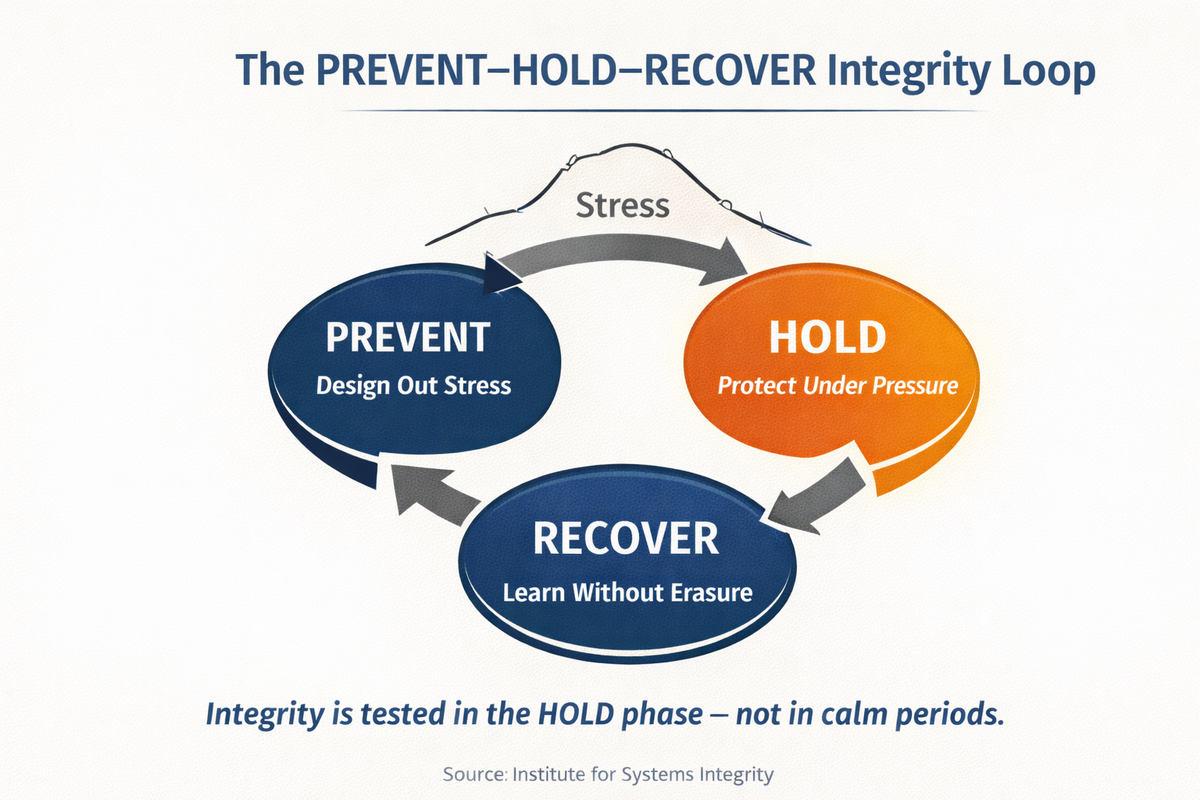
The PREVENT–HOLD–RECOVER Integrity Loop explains how integrity risk evolves across stability, sustained pressure, and recovery, with the HOLD phase posing the greatest threat to decision quality.
Institute for Systems Integrity (ISI)
The PREVENT–HOLD–RECOVER Integrity Loop
Subhead: A governance model for protecting decision quality across stability, stress, and recovery
Definition (canonical)
The PREVENT–HOLD–RECOVER Integrity Loop maps integrity risk across periods of stability, stress, and recovery, identifying the HOLD phase as the point where decision quality is most vulnerable.
Three phases (fixed)
- PREVENT — reduce baseline stress through design, resourcing, clarity, redundancy
- HOLD — protect judgement under sustained constraint, time pressure, uncertainty
- RECOVER — restore capacity and extract learning without erasing memory
How to use
Use this loop to stop treating pressure as temporary noise. “HOLD” is where integrity is tested—and where resilience narratives can mask accumulating risk.
What this is not
Not a crisis response plan. Not a linear incident model. Not a resilience framework.
Relationship to ISI frameworks
This loop provides an operational governance view across the Cascade lifecycle and aligns directly with the resilience warning described in Article 3:
- Systems Integrity Cascade
- When Resilience Appears, Governance Has Already Failed
Applied in
- Article 1: Decision-Making Under System Stress
- Article 3: When Resilience Appears…
Diagram
Insert Diagram 3 (loop).
Caption (locked): Integrity is tested in the HOLD phase — not in calm periods.
Citation
Institute for Systems Integrity (2026). The PREVENT–HOLD–RECOVER Integrity Loop. systemsintegrity.org.