Toolkit Framework #2 - Stress–Signal Conversion Model (SSCM)
The Stress–Signal Conversion Model (SSCM) explains how early warning signals are filtered, normalised, and suppressed before harm occurs.
Institute for Systems Integrity (ISI)
The Stress–Signal Conversion Model (SSCM)
Why early warnings are filtered, normalised, and suppressed before harm occurs
Definition (canonical)
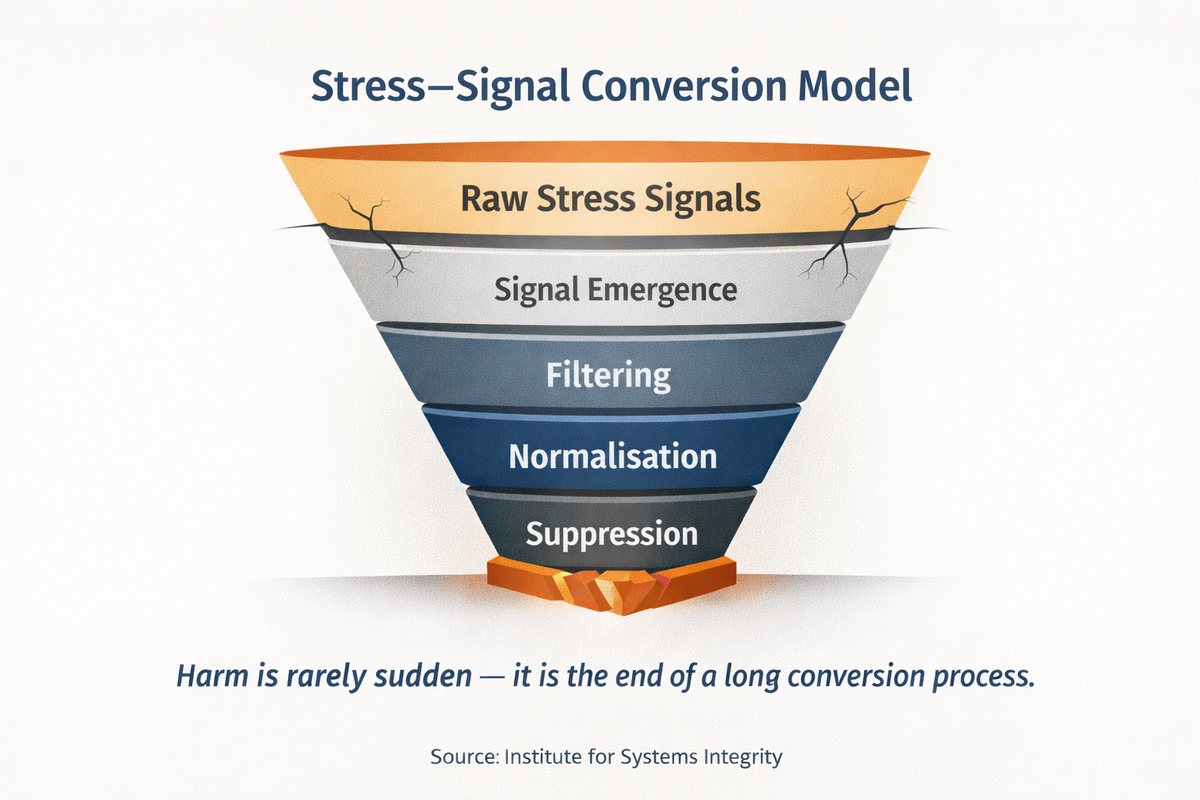
The Stress–Signal Conversion Model describes the systematic process by which early stress signals are filtered, normalised, and suppressed, transforming warning signs into organisational silence before harm occurs.
Four stages (fixed)
- Signal Emergence — near misses, fatigue, delay, discomfort, workaround dependence
- Signal Filtering — dismissed as noise, anecdote, or “not meeting threshold.”
- Signal Normalisation — reframed as “part of the job” or unavoidable
- Signal Suppression — muted due to disruption avoidance, reputational risk, personal cost
How to use
Use SSCM to identify where your organisation is losing its own intelligence—particularly when dashboards remain green, but work is becoming harder, riskier, or more dependent on heroics.
What this is not
Not a whistleblower policy. Not a culture survey. Not a retrospective incident tool.
Relationship to ISI frameworks
SSCM sits inside the Cascade’s “governance mediation → failure dynamics” pathway and complements the Oversight Blindness derived view:
Applied in
- Article 2: Why Oversight Fails Under Pressure
- Article 3: When Resilience Appears, Governance Has Already Failed
Harm is rarely sudden — it is the end of a long conversion process.
Citation
Institute for Systems Integrity (2026). The Stress–Signal Conversion Model (SSCM). systemsintegrity.org.