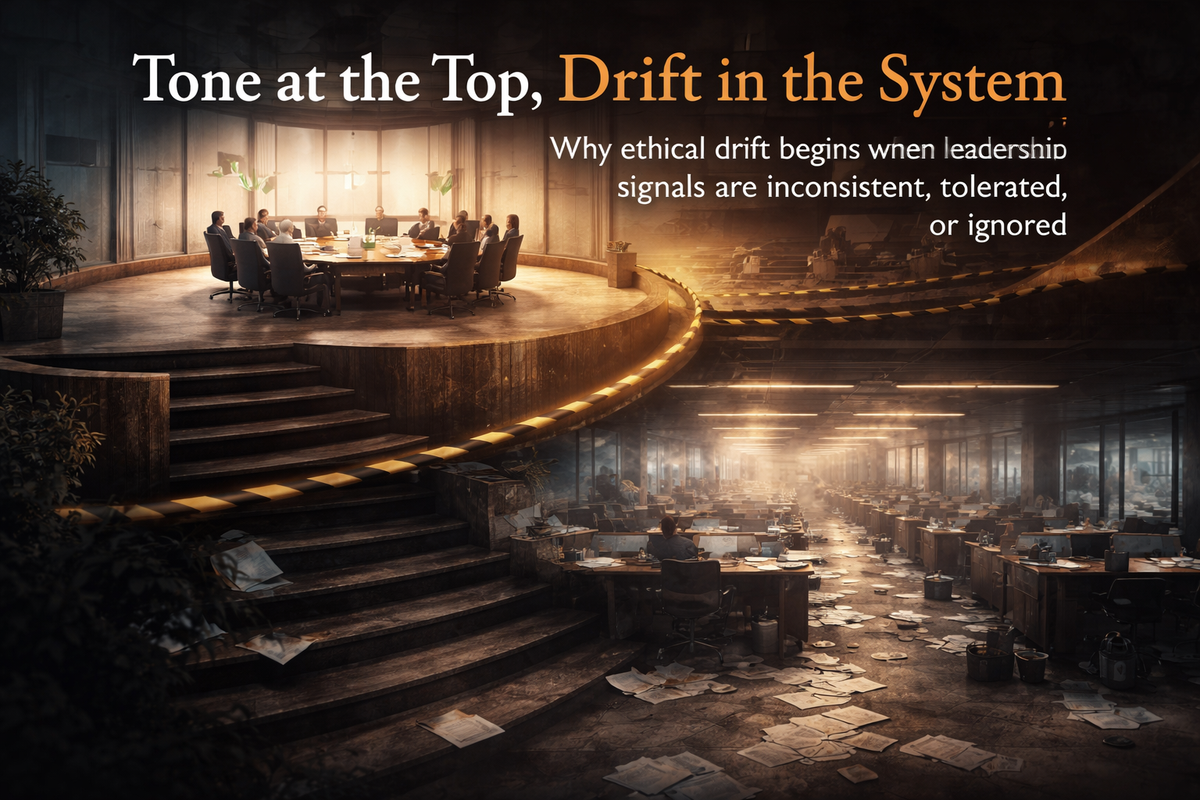
Tone at the Top, Drift in the System: Why ethical drift begins when leadership signals are inconsistent, tolerated, or ignored
Ethical failure rarely begins with misconduct. It begins with inconsistency. This article explores how leadership signals — especially what is tolerated — shape organisational culture and drive systemic drift.
Dr Alwin Tan, MBBS, FRACS, EMBA (Melbourne Business School)
Senior Surgeon | Governance Leader | HealthTech Co-founder |
Harvard Medical School — AI in Healthcare
Australian | Institute of Company Directors — GAICD candidate|
University of Oxford — Sustainable Enterprise
Institute for Systems Integrity (ISI)
Introduction
Most organisations do not fail ethically in a single moment.
They drift.
Quietly.
Gradually.
Often invisibly.
By the time failure becomes visible, it is rarely the result of one decision. It is the accumulation of many small signals, inconsistently applied and insufficiently challenged.
At the centre of this process is a well-established governance concept: tone at the top.
Beyond Statements: What Tone at the Top Really Means
“Tone at the top” is frequently interpreted as leadership communication — the articulation of values, ethics, and expectations.
But tone is not defined by what leaders say.
It is defined by what leaders do, and more importantly, what they tolerate.
Employees do not infer culture from mission statements. They infer it from:
- how decisions are made
- how behaviour is rewarded
- how misconduct is handled
- how consistently standards are applied
As Schein (2010) argues, organisational culture is embedded in shared assumptions formed through repeated behavioural signals — not declared intent.
This aligns closely with guidance from the Australian Institute of Company Directors, which emphasises that boards are responsible not only for setting organisational values, but for ensuring those values are consistently demonstrated and reinforced through behaviour and decision-making.
How Ethical Drift Begins
Ethical drift rarely begins with deliberate misconduct.
It begins with:
- small deviations from expected standards
- inconsistencies in decision-making
- unchallenged behaviours
- selective enforcement of rules
Each instance appears minor in isolation.
However, over time, these actions accumulate and begin to shape collective understanding.
Dekker (2011) describes this as “drift into failure” — a gradual migration of behaviour away from accepted norms, often without conscious awareness.
The Role of Signals in Complex Systems
Organisations are not governed solely by formal policies.
They are governed by signals.
Individuals continuously interpret:
- what leadership prioritises
- what attracts attention
- what is overlooked
- what is permitted to continue
When leadership signals are inconsistent, behaviour becomes inconsistent.
When standards are selectively applied, standards are redefined.
This dynamic aligns with Treviño and Brown’s (2005) work on ethical leadership, which highlights that leader behaviour serves as a primary mechanism through which norms are established and reinforced.
From a governance perspective, the Australian Institute of Company Directors reinforces that culture is not an abstract concept, but a measurable driver of organisational performance and risk, requiring active oversight rather than passive endorsement.
Tolerance as a Cultural Force
Among all leadership signals, tolerance is the most powerful.
What leaders choose not to address communicates as strongly as what they actively endorse.
Tolerance conveys:
“This behaviour is acceptable within this system.”
Even when it contradicts formal values.
This creates a divergence between:
- stated values
- experienced reality
Over time, this gap becomes the foundation of cultural drift.
The Governance Blind Spot
Boards and executive teams often focus on:
- strategy execution
- financial performance
- regulatory compliance
While these are essential, culture operates differently.
It is:
- decentralised
- behavioural
- emergent
And therefore less visible through traditional governance metrics.
Both ASIC (2016) and the Australian Institute of Company Directors highlight that organisational conduct is shaped not just by formal frameworks, but by the consistency of leadership behaviour and responses to issues over time.
From Inconsistency to Systemic Risk
When inconsistency is left unaddressed:
- standards erode
- expectations shift
- trust diminishes
- risk accumulates
Crucially, this process is rarely recognised as risk in its early stages.
It presents as:
- isolated incidents
- “one-off” exceptions
- pragmatic compromises
Only later does it become clear that these were not isolated events, but signals of a system adjusting its own boundaries.
Reason (1990) describes this phenomenon as the accumulation of latent conditions — where systemic vulnerabilities develop long before failure occurs.
From a board perspective, this represents a failure of early risk detection, where cultural drift is not identified until it manifests as reputational, regulatory, or operational failure.
From Tone to Alignment: The Board’s Role
Effective governance requires more than setting tone.
It requires ensuring alignment between:
- what is said
- what is done
- what is reinforced
This involves:
- consistent responses to behaviour
- early intervention in small deviations
- visible accountability
- reinforcement of standards through decision-making
The Australian Institute of Company Directors consistently emphasises that boards must move beyond passive oversight of culture to active stewardship, ensuring that organisational values are operationalised — not merely articulated.
The Critical Governance Question
The central question for boards and leaders is not:
“Have we defined the right values?”
It is:
“Where are our signals inconsistent — and what are we tolerating?”
Conclusion
Ethical failure is rarely sudden.
It is the result of accumulated signals, interpreted over time.
Culture does not fail because values are unclear.
It fails when leadership signals are inconsistent — and when behaviour that contradicts those values is allowed to persist.
📚 References (Harvard Style)
ASIC (2016) Tone from the top: Influencing conduct and culture. Australian Securities and Investments Commission.
Dekker, S. (2011) Drift into Failure: From Hunting Broken Components to Understanding Complex Systems. Farnham: Ashgate.
Reason, J. (1990) Human Error. Cambridge: Cambridge University Press.
Schein, E.H. (2010) Organizational Culture and Leadership. 4th edn. San Francisco: Jossey-Bass.
Treviño, L.K. and Brown, M.E. (2005) ‘The role of leaders in influencing unethical behavior in organizations’, Business Ethics Quarterly, 15(1), pp. 69–80.
Australian Institute of Company Directors (2019) Driving organisational performance through culture: Future of governance. Sydney: AICD.