
The Systems Integrity Cascade
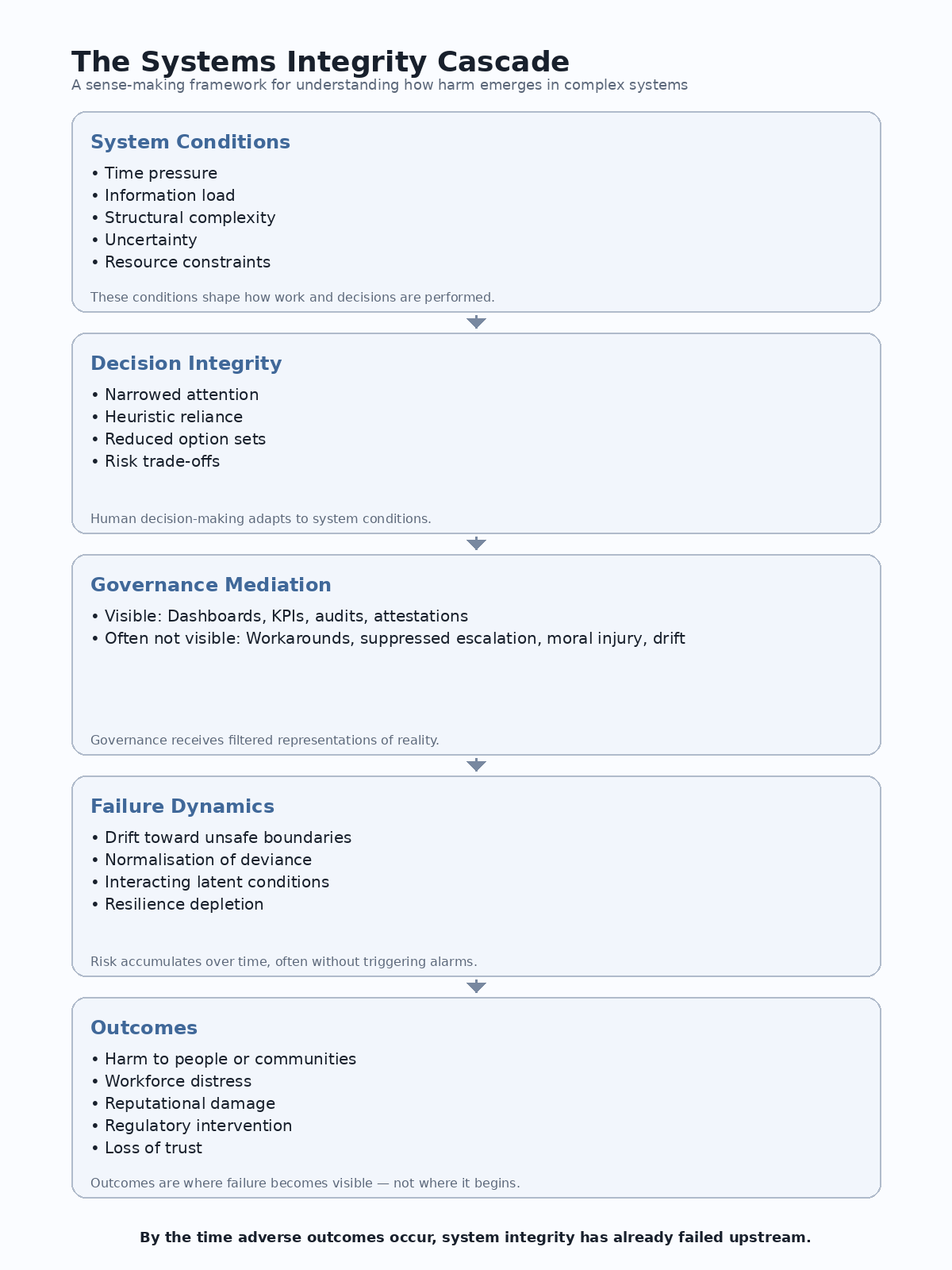
A sense-making framework for understanding how harm emerges in complex systems
Why this framework exists
Across sectors, serious failures continue to occur despite regulation, compliance systems, and professional expertise.
Post-incident reviews often focus on individual decisions or procedural breaches. While these matters, they rarely explain why similar failures recur across different organisations and contexts.
The Systems Integrity Cascade was developed to address this gap.
It provides a structured way to understand how system conditions shape decision-making, how governance mediates what is seen and unseen, and how harm can emerge without malice long before outcomes become visible.
What the Cascade shows
The framework maps five interacting layers present in all complex organisations:
- System Conditions
The structural pressures that shape work include time constraints, information load, complexity, uncertainty, and resource limitations. - Decision Integrity
How human decision-making adapts under those conditions, including narrowed attention and reliance on experience-based heuristics. - Governance Mediation
How reality is filtered through dashboards, reports, audits, and assurance mechanisms — and what is not visible to oversight. - Failure Dynamics
How risk accumulates over time through drift, normalisation of deviance, interacting latent conditions, and resilience depletion. - Outcomes
The point at which harm becomes visible through adverse events, regulatory intervention, workforce distress, or loss of trust.
The Cascade makes explicit a central insight:
By the time adverse outcomes occur, system integrity has already failed upstream.
What this framework is — and is not
The Systems Integrity Cascade is:
- A conceptual architecture for sense-making
- A tool for inquiry, reflection, and governance learning
- A way to locate responsibility without scapegoating
It is not:
- A compliance checklist
- A maturity model or scoring system
- A certification framework
- A substitute for professional or regulatory judgment
The framework is intentionally non-prescriptive. Its purpose is to support better questions, not provide false certainty.
How the Cascade is used
The Institute for Systems Integrity uses the Cascade to:
- analyse decision-making under pressure
- Examine governance failure modes
- inform board and regulatory discussions
- frame upstream interventions before harm occurs
It is applied across healthcare, public administration, infrastructure, technology, and other complex socio-technical systems.
Foundational work
The following articles apply the Systems Integrity Cascade in practice:
- Decision-Making Under System Stress
Why Good People Make Predictably Weaker Decisions — and What Integrity Requires
(Additional publications will be added as the Institute’s work develops.)
Citation
This framework may be cited as:
Tan, A. (2025). The Systems Integrity Cascade. Institute for Systems Integrity.
Closing statement
Integrity is not demonstrated after failure.
It is demonstrated by what systems allow — or force — people to do before harm occurs.
© 2026 Institute for Systems Integrity. All rights reserved.
Content may be quoted or referenced with attribution.
Commercial reproduction requires written permission.