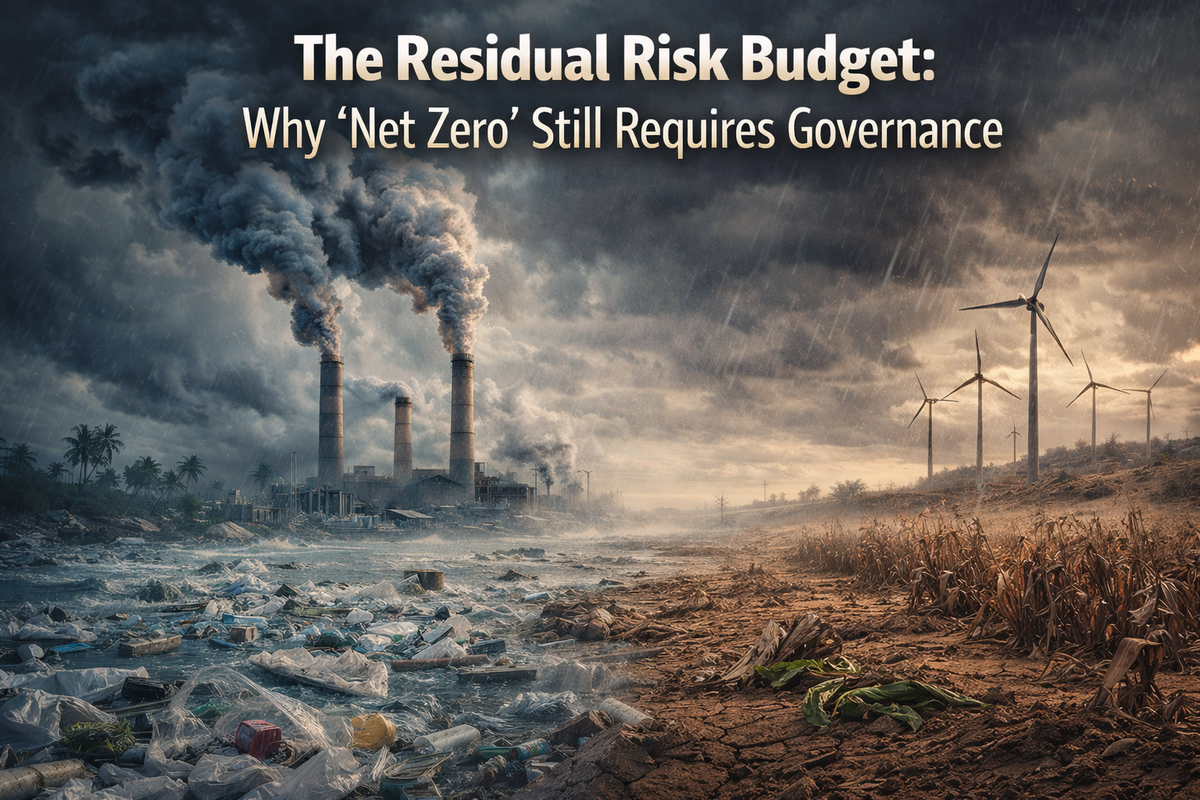
The Residual Risk Budget: Why “Net Zero” Still Requires Governance
Net zero is often framed as an endpoint. In reality, residual emissions, harms, and uncertainties persist. ISI introduces the Residual Risk Budget — a systems integrity lens that makes remaining exposure visible, owned, and governable across boards, regulators, and institutions.
Dr Alwin Tan, MBBS, FRACS, EMBA (University of Melbourne), AI in Healthcare (Harvard Medical School)
Senior Surgeon | Governance Leader | HealthTech Co-founder |Harvard Medical School — AI in Healthcare |
Australian Institute of Company Directors — GAICD candidate
University of Oxford — Smith School of Enterprise and the Environment (Sustainable Enterprise)
Institute for Systems Integrity (ISI)
Abstract
Net zero is frequently framed as an end state achieved through emissions reduction, substitution, and offsetting. While technically useful, this framing is governance-incomplete. Even under credible net-zero pathways, residual emissions, residual harms, and residual uncertainties persist. They do not disappear; they are redistributed across time, geography, and stakeholders.
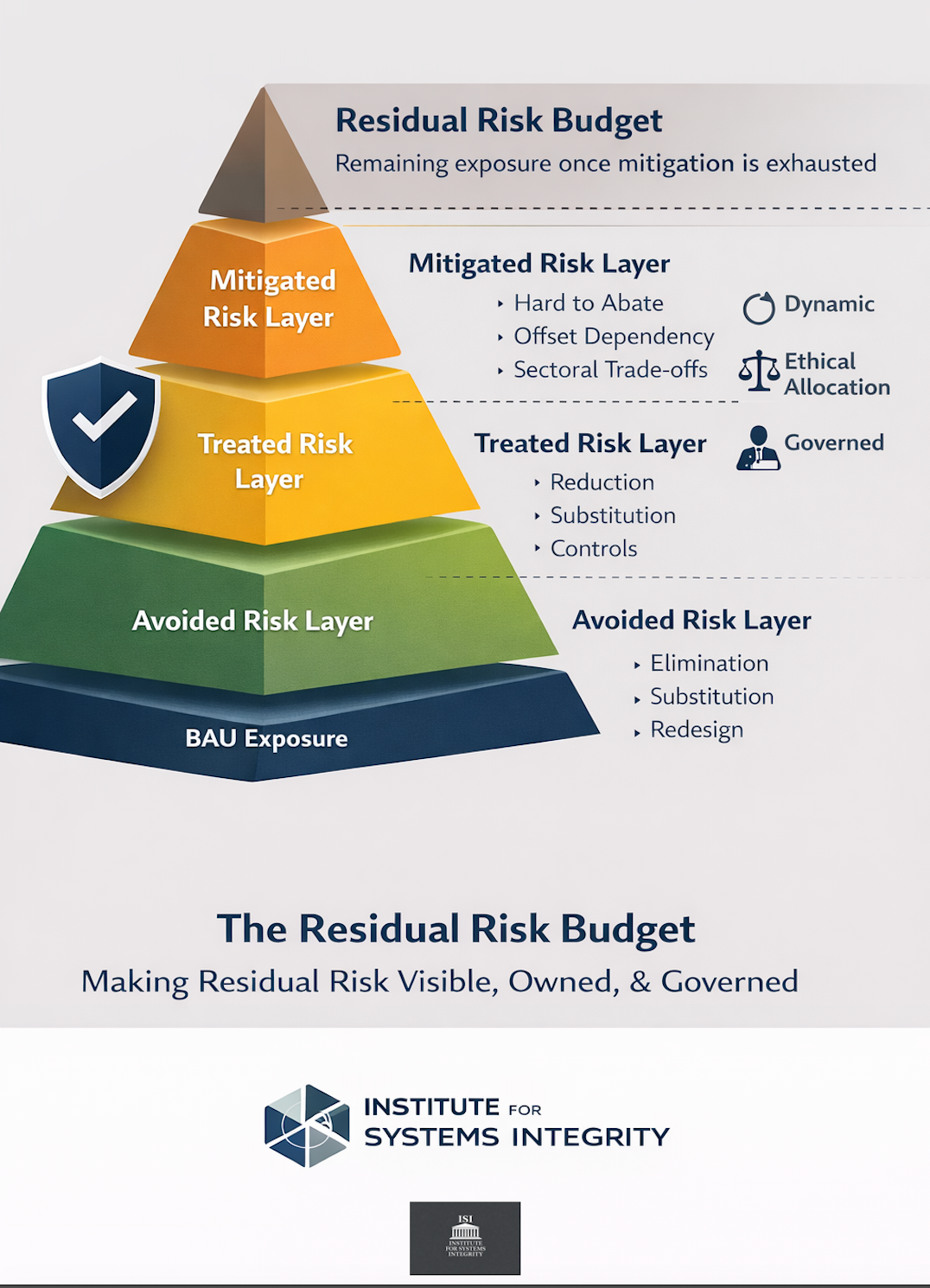
This paper introduces the concept of the Residual Risk Budget — the remaining exposure a system accepts after mitigation efforts are exhausted. Drawing on risk governance, wicked problems leadership, and Systems Integrity frameworks, we argue that residual risk must be made visible, explicitly owned, and adaptively governed. Without this discipline, net zero risks devolve into an accounting construct that obscures ethical allocation decisions and accelerates integrity drift.
1. Net Zero as a Governance Condition
Net zero is often communicated as closure — implying that climate impact has been neutralised. Climate science and transition economics suggest otherwise.
Hard-to-abate emissions remain.
Offsets introduce durability and verification risks.
Transition pathways generate uneven social, operational, and financial consequences.
From a governance perspective, net zero is therefore not an endpoint, but a continuing condition of managed residual risk.
Sustainability transition frameworks emphasise balancing multiple forms of capital — natural, human, financial, and institutional. Actions stabilising one domain frequently generate residual exposure in another. Governance must explicitly recognise and oversee these reallocations.
2. Defining the Residual Risk Budget
The Residual Risk Budget refers to:
The remaining exposure to harm, instability, or unintended consequence after mitigation strategies have been applied.
This includes:
• Residual emissions
• Residual ecological impact
• Residual social and workforce effects
• Residual uncertainty
In safety-critical sectors, residual risk is never treated as invisible. It is identified, documented, owned, reviewed, and formally accepted.
Many net zero strategies, however, treat residual harm as implicit — embedded within modelling assumptions, reporting boundaries, or offset frameworks.
This creates a governance blind spot.
3. Residual Risk and Integrity Drift
When residual exposure is not explicitly governed, systems become vulnerable to Integrity Drift — the progressive misalignment between formal compliance and operational reality.
Observed patterns include:
• Technically compliant decisions producing unintended harm
• Trade-offs made without transparent ethical framing
• Diffusion of responsibility to frontline actors
• Delayed recognition of systemic instability
Residual harm that remains unnamed becomes residual harm that remains ungoverned.
4. The Invisibility Problem
Failure to govern residual risk produces predictable distortions:
a) Opaque Trade-Offs
Acceptable harm migrates into technical abstraction.
b) Default Harm Allocation
Residual burdens fall on stakeholders with the least structural power.
c) False Assurance
Disclosure adequacy is mistaken for risk containment.
Governance guidance consistently stresses that boards are responsible for oversight of risk, resilience, and long-term value preservation. Residual climate exposure falls squarely within this mandate.
5. Residual Risk as a Wicked Problem Dynamic
Residual risk exhibits defining characteristics of wicked problems:
• No definitive resolution
• Interdependent consequences
• Adaptive system responses
• Persistent ethical tension
Attempts to eliminate one form of harm frequently intensify another. Governance failure occurs when institutions deny or obscure this structural reality.
6. The Pause Principle and Residual Risk Governance
Residual risk governance requires institutional capacity to pause under pressure.
The Pause Principle recognises that urgency compresses judgment, narrows option sets, and accelerates reactive decision-making. In complex transitions, this may result in:
• Premature closure of uncertainty
• Under-examined reliance on offsets
• Short-term optimisation over long-term stability
Pause is not a delay. It is a governance safeguard protecting reflection when the stakes are highest.
7. An Integrity-Based Governance Response
ISI proposes three structural requirements:
1️⃣ Visibility
Residual harms must be explicitly defined and surfaced.
2️⃣ Ownership
Residual exposure requires named accountability:
• System Owner
• Decision Owner
• Oversight Body
3️⃣ Iterative Review
Residual risk evolves with science, regulation, technology, and system behaviour.
8. Implications for Boards and Regulators
Boards should ask:
What harms remain?
Who absorbs residual exposure?
What assumptions underpin acceptability?
How is integrity drift detected?
Regulators should examine:
• Whether disclosure frameworks adequately surface residual harm
• Offset dependency and durability risks
• Distributional consequences of residual exposure
Net zero without residual risk governance risks stabilising metrics while destabilising systems.
Conclusion
Residual harm is not an accounting remainder.
It is a governance reality.
Net zero is therefore not merely a sustainability target, but a continuing integrity discipline requiring visibility, ownership, and adaptive oversight.
References
Australian Institute of Company Directors (AICD) (2019) Director Tools: Risk Oversight and Governance. Sydney: AICD.
Institute for Systems Integrity (ISI) (2025) Integrity Drift: Why Compliance Does Not Guarantee Integrity. Melbourne: Institute for Systems Integrity.
Institute for Systems Integrity (ISI) (2025). The Pause Principle: Why Governance Fails When Reaction Replaces Reflection. Melbourne: Institute for Systems Integrity.
Intergovernmental Panel on Climate Change (IPCC) (2023) AR6 Synthesis Report: Climate Change 2023. Geneva: IPCC.
International Organization for Standardization (ISO) (2018) ISO 31000: Risk Management – Guidelines. Geneva: ISO.
Rockström, J. et al. (2009) ‘A safe operating space for humanity’, Nature, 461, pp. 472–475.
Snowden, D.J. and Rancati, A. (2021). Managing complexity (and chaos) in times of crisis. Cognitive Edge.
University of Oxford, Smith School of Enterprise and the Environment (SSEE) (2023). Principles of Sustainable Finance and Net Zero Transitions. Oxford: SSEE.