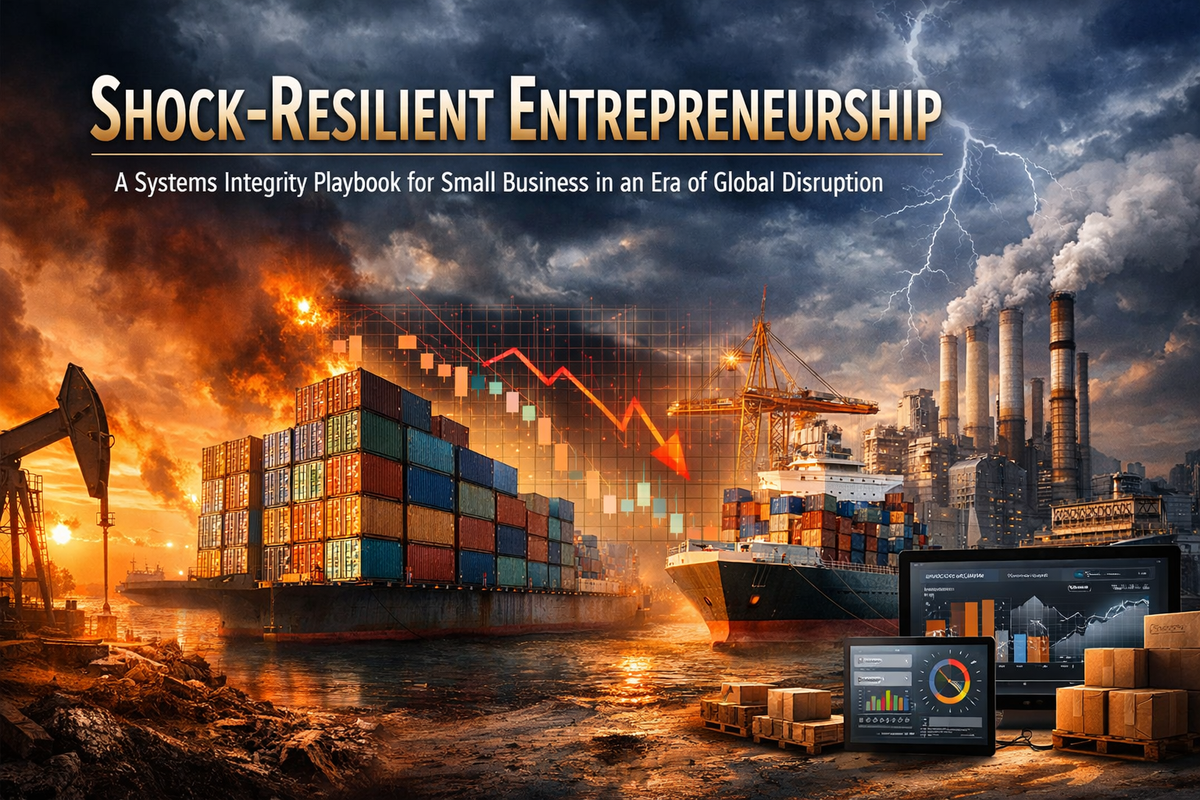
Shock-Resilient Entrepreneurship: A Systems Integrity Playbook for Small Business in an Era of Global Disruption
In an era of geopolitical instability and energy shocks, small businesses face cascading risks. This ISI playbook shows how to strengthen cash discipline, pricing, supply chains, and decision systems to navigate disruption with clarity and resilience.
Myles Kelly, EMBA (Melbourne Business School)
Founder | Director | CEO | Master of Entrepreneurship candidate (University of Melbourne)Faculty Advisor, Institute for Systems Integrity (ISI)
&
Dr Alwin Tan, MBBS, FRACS, EMBA (Melbourne Business School)
Senior Surgeon | Governance Leader | HealthTech Co-founder |
Harvard Medical School — AI in Healthcare |
Australian Institute of Company Directors — GAICD candidate |
University of Oxford — Sustainable Enterprise
Institute for Systems Integrity (ISI)
Global shocks rarely arrive in isolation.
Energy crises, geopolitical conflicts, inflationary pressure, and supply chain instability tend to emerge simultaneously, creating cascading disruptions across economic systems.
For small businesses and entrepreneurs, these moments are existential.
Unlike large corporations, small firms operate with thinner margins, shorter cash runways, and more limited access to capital markets. When oil prices spike due to geopolitical instability—such as conflict in the Middle East—the effects propagate rapidly across logistics, production costs, consumer prices, and financial markets.
Yet history shows that while crises destroy some businesses, they accelerate others.
The difference is rarely luck.
It is system design, decision discipline, and resilience architecture.
This paper examines evidence from economic research, management literature, and crisis case studies to develop a practical playbook for entrepreneurs navigating systemic disruption.
1. The Nature of Shock: Why Energy Crises Spread Through Entire Economies
Oil shocks historically trigger broad macroeconomic disruption.
Energy is a foundational input for modern economies. When prices rise sharply due to geopolitical conflict or supply disruption, the effects cascade across:
- transport and freight
- manufacturing inputs
- agriculture
- electricity generation
- consumer prices
- monetary policy responses
Economic research consistently shows that energy price shocks contribute to inflation, reduced consumer spending, and lower economic growth (Hamilton, 2009).
For small businesses, the transmission mechanism is particularly acute.
They experience:
• rising operating costs
• delayed customer payments
• reduced demand
• tightening credit conditions
• supply chain instability
The OECD has repeatedly highlighted that small and medium enterprises (SMEs) are more sensitive to economic shocks due to lower liquidity buffers and weaker bargaining power in supply chains (OECD, 2024).
In practical terms, small businesses do not simply face higher fuel costs.
They face a simultaneous deterioration of multiple economic variables.
This systemic nature of disruption is what transforms geopolitical events into entrepreneurial crises.
Additional system insight:
Energy tariffs and production-side cost shifts not only destabilise direct supply chains. They can significantly extend manufacturing timelines, introducing hidden delays that compound operational risk.
2. Why Some Firms Survive While Others Collapse
Crisis management research consistently shows that organisational resilience depends less on size and more on adaptive capacity.
A major cross-industry review found that firms surviving systemic shocks typically demonstrate three characteristics:
- operational flexibility
- financial resilience
- rapid decision cycles (Duchek, 2020)
In contrast, firms that fail tend to exhibit:
• delayed recognition of disruption
• rigid cost structures
• overdependence on single suppliers
• insufficient liquidity
Entrepreneurship research further shows that resilience is not a personality trait, but a strategic capability embedded within systems and processes (Williams et al., 2017).
Survival, therefore, is rarely determined by founder optimism or grit alone.
It is determined by whether the organisation was designed to adapt.
Critical extension:
Organisations must deliberately allocate time and resources to foresight and future planning. The signals of disruption are often present—but unexamined. True resilience requires not only analysing available data, but actively questioning what is missing from the data.
3. The First Rule of Crisis: Cash Is Oxygen
During systemic shocks, liquidity becomes the most critical variable for survival.
World Bank research shows that firms with stronger cash reserves and access to credit are significantly more likely to survive crises (World Bank, 2020).
Cash flow deteriorates rapidly during disruption because:
• demand becomes volatile
• payment cycles lengthen
• suppliers tighten terms
• lenders become more conservative
The first operational step is therefore cash visibility.
This requires weekly tracking of:
- cash runway
- accounts receivable ageing
- accounts payable obligations
- inventory exposure
Businesses that understand their liquidity position early gain the most valuable asset in uncertainty:
time.
Operational extension:
Cash constraints can also act as a catalyst for innovation, creativity, and collaboration. Regular auditing of outgoings, exploring alternative financing options, and leveraging emerging lending products can provide critical short-term flexibility—even at higher cost—while preserving organisational stability.
4. Pricing Under Inflation: The Margin–Volume Trade-off
Pricing becomes one of the most difficult decisions during cost shocks.
Raise prices too aggressively and demand falls.
Absorb costs too long, and the business erodes.
Research shows firms frequently misjudge demand elasticity during inflationary periods (Liu & Atkin, 2023).
Customer responses vary across segments, products, and geographies.
Effective pricing strategies, therefore, rely on precision, not uniformity.
Entrepreneurs should consider:
• selective price increases on inelastic products
• maintaining entry-level offerings
• introducing smaller formats or service tiers
• clearly communicating value
Transparency often preserves trust more effectively than silent margin compression.
Strategic extension:
Inflation provides an opportunity to re-engineer the pricing architecture. Everything should be revisited—cost structure, minimum order quantities, supplier agreements, and value positioning. If the value proposition remains strong, pricing resilience follows.
5. Supply Chains: The Hidden Fragility
The COVID-19 pandemic exposed global supply chain fragility.
Energy shocks reinforce it.
Oil price increases affect not only fuel costs, but also:
- freight rates
- shipping insurance
- transport reliability
- production inputs
Research shows firms dependent on single suppliers or logistics routes are disproportionately vulnerable (WEF, 2023).
Resilient organisations adopt diversification strategies:
• secondary suppliers
• regional sourcing
• shorter supply chains
• targeted inventory buffers
These measures may increase costs in stable periods, but dramatically reduce risk during disruption.
Operational reality:
Freight bottlenecks—particularly at ports and unloading points—can delay goods for weeks, even after arrival. Businesses must model worst-case scenarios in forecasting, rather than assuming smooth continuation of logistics chains.
6. Digitalisation as a Crisis Multiplier
Crisis-resilient firms typically accelerate digital adoption.
HBR research shows digitally enabled businesses adapt faster and access alternative revenue channels during disruption (HBR, 2021).
Digital systems support:
• forecasting accuracy
• financial visibility
• online sales
• remote service delivery
• customer engagement
However, technology alone is insufficient.
Digitalisation only delivers value when embedded into process redesign and decision-making systems.
Execution insight:
Organisations should actively manage their technology stack—assign ownership, review effectiveness, and continuously question whether there is a better way to achieve outcomes. When aligned correctly, digitalisation delivers both efficiency and organisational relief.
7. Strategic Pivoting: Adaptation Without Losing Identity
Crisis-driven pivots often fail due to a lack of validation.
Successful pivots share three characteristics:
- They build on existing capabilities
- They solve urgent customer problems
- They maintain brand coherence
Examples include:
• restaurants shifting to delivery
• manufacturers producing essential goods
• service firms moving to digital or subscription models
The governing principle is adjacent innovation—not reinvention.
Strategic anchor:
Leadership must remain aligned with the overarching corporate strategy. Adaptation should not become reactive drift. Where necessary, strategy should be clarified first, then innovation executed in alignment with it.
8. Leadership in Uncertainty
Leadership behaviour becomes amplified during crisis.
Effective leaders demonstrate:
• transparency
• clarity of priorities
• rapid decision-making
• visible engagement
Uncertainty spreads faster than disruption itself.
Clear communication stabilises organisations.
Decision discipline:
Maintain structured decision frameworks, even under time pressure. Where appropriate, apply models such as reversible vs irreversible decisions (“two-way door” thinking), enabling rapid but controlled action.
9. The Systems Integrity Perspective
Crises expose what systems conceal in stable conditions.
Oil shocks do not simply increase costs.
They reveal dependencies:
• concentrated supply chains
• energy-intensive models
• weak liquidity structures
• fragile logistics systems
Entrepreneurs who treat crises as diagnostic events gain strategic advantage.
They identify structural weaknesses and redesign for resilience.
Critical practice:
Conduct post-mortem and pre-mortem analysis.
Ask: What if everything fails?
This reveals hidden risks—and often, hidden opportunities.
10. The Entrepreneur’s Crisis Playbook
Entrepreneurs navigating disruption should follow five core principles:
1. Stabilise cash
Measure liquidity weekly and extend the runway.
2. Protect margin intelligently
Use targeted pricing, not blunt increases.
3. De-risk supply chains
Diversify inputs and logistics pathways.
4. Increase operational visibility
Invest in systems that improve decision speed.
5. Communicate continuously
Transparency builds trust across stakeholders.
Relational insight:
Do not hesitate to engage partners and suppliers. Strong relationships often unlock extended terms, prioritisation, and support. In challenging environments, openness strengthens—not weakens—commercial relationships.
Conclusion
Global disruption is no longer episodic—it is structural.
Geopolitics, energy volatility, climate pressures, and technological change are reshaping the operating environment for all businesses.
For small enterprises, survival will not depend on predicting shocks, but on designing systems capable of absorbing them.
Resilient organisations do not eliminate uncertainty.
They build systems that withstand stress, adapt quickly, and emerge stronger.
In this environment, resilience is no longer a competitive advantage.
It is a condition of survival.
References (Harvard Style)
Duchek, S. (2020). Organisational resilience: A capability-based conceptualisation. Business Research, 13(1), pp.215–246.
Hamilton, J.D. (2009). Causes and consequences of the oil shock of 2007–08. Brookings Papers on Economic Activity.
Harvard Business Review (2021). Lessons on resilience for small and midsize businesses. Harvard Business Review.
Liu, Y. & Atkin, T. (2023). Navigating the mood of customers weary of price hikes. Harvard Business School Working Knowledge.
OECD (2024). Financing SMEs and Entrepreneurs 2024: An OECD Scoreboard. Paris: OECD Publishing.
Williams, T.A., Gruber, D.A., Sutcliffe, K.M., Shepherd, D.A. & Zhao, E.Y. (2017). Organisational response to adversity: Fusing crisis management and resilience research streams. Academy of Management Annals.
World Bank (2020). Small and Medium Enterprises in the Pandemic: Impact, Responses and the Role of Development Finance. Washington DC.
World Economic Forum (2023). Global Supply Chain Resilience Report. Geneva.