Seven Lenses Every Board Should Be Testing — Constantly
A governance diagnostic framework outlining seven lenses boards should continuously test to detect early signal failure, strengthen oversight, and prevent integrity drift before risks become visible.
Boards rarely fail because of a single decision.
Failure emerges when signals are missed, filtered, or normalised over time.
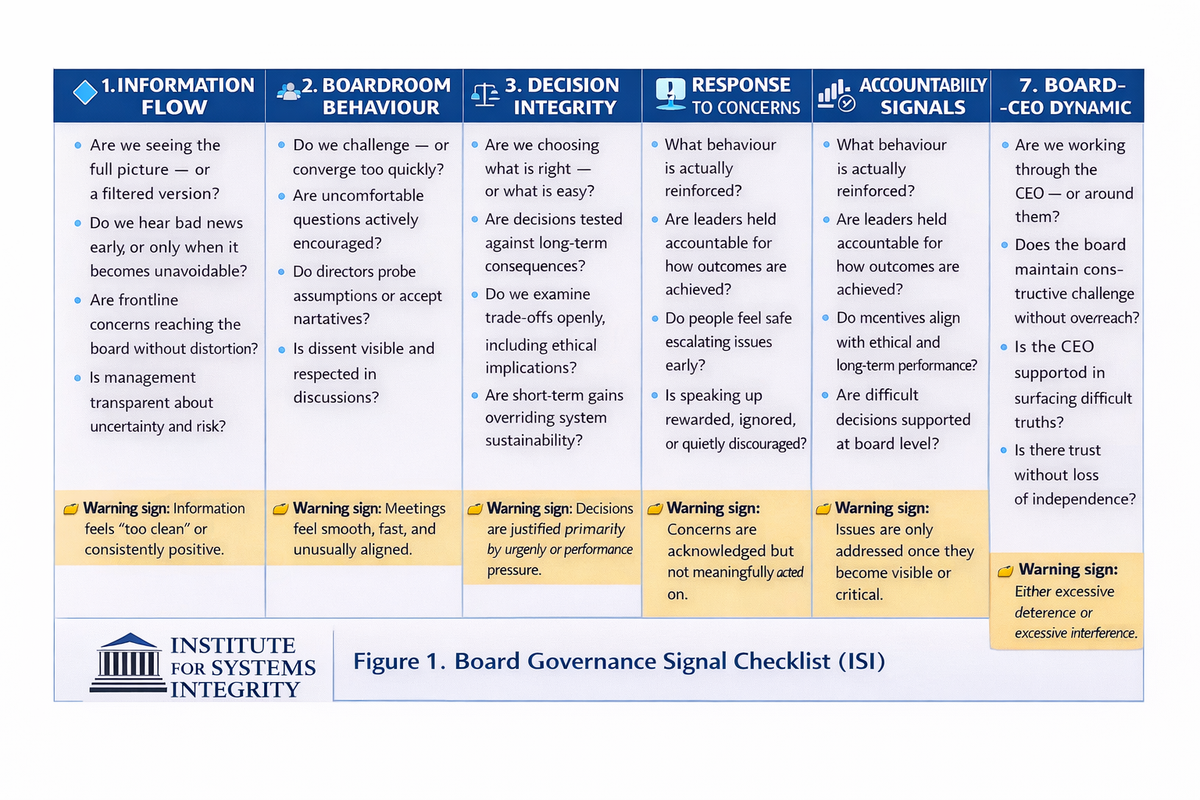
This framework outlines seven governance lenses designed to detect early signal failure and strengthen board oversight. Each lens focuses on how information flows, how decisions are challenged, and how accountability is reinforced within the system.
These lenses are not a checklist.
They are intended to be applied continuously — as part of how boards interrogate information, test assumptions, and monitor for early signs of integrity drift.
How to use this framework:
Boards can apply one lens per meeting or use all seven as a structured diagnostic during strategy, risk, or audit discussions. The objective is not confirmation — but detection of weak or emerging signals.
🔷 The Seven Lenses
1. Information Flow
Examines whether the board is receiving an unfiltered view of reality. Focus on how bad news travels, whether uncertainty is disclosed, and whether frontline signals reach the board without distortion.
2. Boardroom Behaviour
Assesses how the board engages with information. Strong governance requires visible challenge, constructive dissent, and active probing of assumptions — not passive alignment.
3. Decision Integrity
Tests whether decisions are grounded in long-term value and ethical consideration. Boards should examine trade-offs explicitly and resist pressure to prioritise short-term performance over system sustainability.
4. Response to Concerns
Evaluates how the organisation reacts when issues are raised. Early signals are only valuable if they are explored, escalated appropriately, and acted upon without defensiveness or minimisation.
5. Accountability Signals
Focuses on what behaviour is actually reinforced. Incentives, performance measures, and leadership responses should align with how outcomes are achieved — not just the outcomes themselves.
6. Early Signal Detection
Assesses the organisation’s ability to recognise weak signals before they escalate. This includes revisiting prior concerns, identifying patterns, and avoiding the normalisation of deviance.
7. Board–CEO Dynamic
Examines the balance between support and challenge. Effective governance requires trust, independence, and a relationship that enables difficult truths to surface without fear or interference.
At the Institute for Systems Integrity (ISI), we view governance as the design of how truth travels through an organisation.
Governance failure rarely appears suddenly.
It emerges as a pattern — visible only to those looking for signals early.
© 2026 Institute for Systems Integrity. All rights reserved.
Content may be quoted or referenced with attribution.
Commercial reproduction requires written permission.