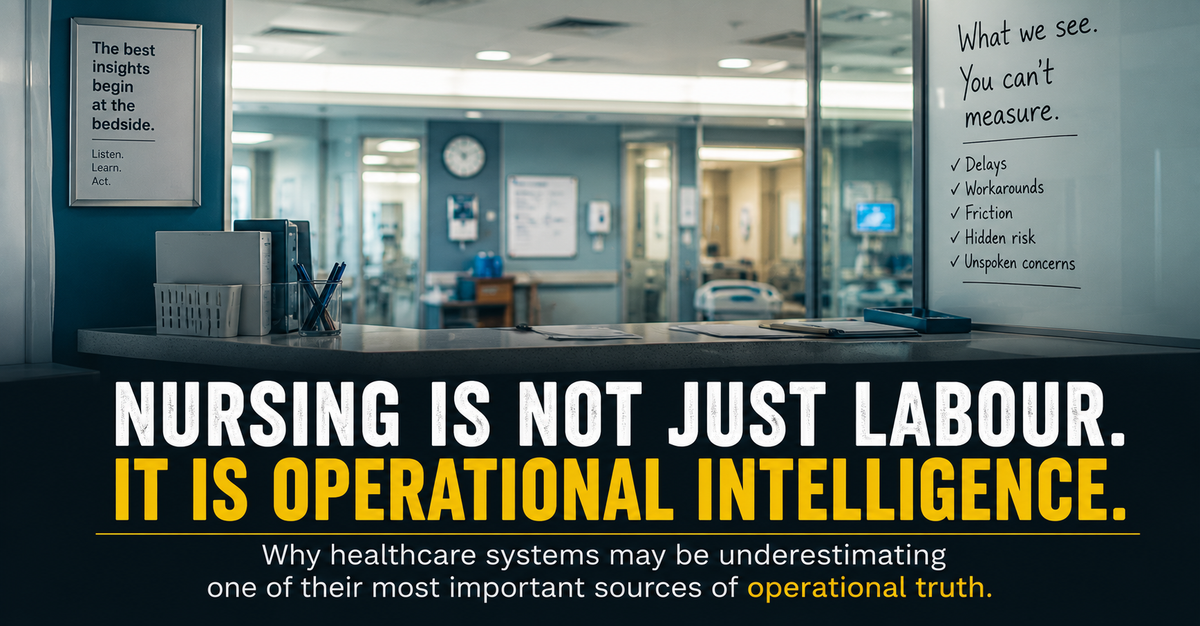
Nursing Is Not Just Labour. It Is Operational Intelligence : Why healthcare systems may be underestimating one of their most important sources of operational truth
Healthcare increasingly measures nursing through staffing, labour costs and productivity. This article argues that nursing is far more than workforce capacity—it is one of healthcare's most important sources of operational intelligence and organisational truth.
Co-authors:
Florinda Frentescu, BNurs.(Monash),BSc.(Monash)
Senior Nurse Manager | MBA Candidate, Melbourne Business School | HealthTech Co-Founder | Harvard Business School (Sustainability) | Monash Science Alum | Bastas Academy for Healthcare Leadership Alum
Dr Alwin Tan, GAICD, MBBS, FRACS, EMBA (Melbourne Business School)
Senior Surgeon | Governance Leader | HealthTech Co-founder |
Harvard Medical School — AI in Healthcare |
Australian Institute of Company Directors — GAICD graduate |
University of Oxford — Sustainable Enterprise
Institute for Systems Integrity
Abstract
Healthcare organisations increasingly govern through dashboards, performance metrics, predictive analytics, command centres and executive reporting systems.
Yet many of the earliest and most consequential signals of operational instability continue to emerge from frontline nursing experience.
Nurses detect deterioration, identify workflow breakdown, coordinate fragmented care, manage transitions, recognise unsafe discharge conditions and compensate for system failures long before these problems become visible in formal reporting.
This paper argues that nursing should not be understood solely as labour capacity or bedside care delivery. Nurses also function as a distributed operational intelligence system.
Viewed through operations principles such as gemba, kaizen, flow, variation, bottleneck recognition and frontline problem-solving, nursing knowledge represents one of healthcare’s most valuable—and most frequently underused—sources of operational truth.
When healthcare organisations fail to capture, protect and act upon this intelligence, they risk becoming increasingly data-rich while simultaneously losing contact with operational reality.
Introduction
Hospitals often assume operational intelligence resides in:
- executive dashboards;
- performance meetings;
- financial reports;
- incident databases;
- command centres;
- predictive models;
- and artificial intelligence systems.
But some of the most important operational knowledge in healthcare is generated much closer to the bedside.
Nurses do not simply complete tasks.
They coordinate fragmented systems.
They detect deterioration.
They manage interruptions.
They identify bottlenecks.
They recognise when a discharge plan is technically complete but operationally unsafe.
They see when staffing numbers appear adequate but the skill mix is not.
They know when a new digital workflow has increased rather than reduced work.
They often stabilise the system before the system formally recognises that it has become unstable.
In practice, healthcare already relies on nursing not only as workforce capacity, but as operational sensing infrastructure.
Yet nursing is still frequently measured primarily through labour-oriented categories:
- staffing ratios;
- roster expenditure;
- vacancies;
- overtime;
- agency utilisation;
- and productive hours.
These measures matter. But they capture only part of nursing’s organisational value.
They measure the workforce deployed.
They do not necessarily measure the intelligence generated.
That distinction matters because healthcare organisations may possess more operational data than ever while remaining dangerously disconnected from the conditions under which care is actually delivered. The original paper correctly identifies this widening gap between formal data and frontline operational truth.
The Hospital Has a Gemba
In lean operations, gemba refers to the actual place where value is created and where problems become observable.
For healthcare, the gemba is not the executive meeting room.
It is the ward.
The medication room.
The emergency department corridor.
The operating theatre.
The discharge conversation.
The bedside at 2 a.m.
The handover where critical context may either be preserved or lost.
Going to the gemba means observing how work actually occurs rather than relying exclusively on how policies, process maps or dashboards suggest it occurs. Lean practice emphasises direct engagement with the place where work is performed so leaders can compare reported performance with operational reality.
Nurses live at the healthcare gemba.
They see the difference between the designed process and the executable process.
They know which forms duplicate work.
They know which escalation pathways respond quickly and which exist largely on paper.
They recognise when a supposedly minor delay will disrupt the remainder of a patient’s care pathway.
They observe the consequences of organisational decisions at the point where those decisions become real.
This does not mean every frontline observation is automatically correct or universally representative.
It means frontline nursing experience contains information that cannot be reconstructed completely from aggregated data.
A dashboard may report that discharge documentation was completed.
A nurse may know that the patient remained confused, the family was not ready, transport was uncertain and follow-up instructions were unlikely to be understood.
The metric records completion.
The nurse perceives fragility.
Both are data.
Only one may reveal the emerging risk.
Nurses as Distributed Operational Sensors
Hospitals are complex adaptive systems.
Risk rarely appears in one place, in one form or at one moment.
It emerges through weak signals distributed across multiple interactions.
A missed medication may appear isolated.
A delayed review may appear manageable.
A family complaint may appear anecdotal.
A difficult handover may appear interpersonal.
A late discharge may appear administrative.
But when experienced repeatedly across the system, these events may indicate:
- deteriorating coordination;
- unsafe workload;
- process congestion;
- communication failure;
- inadequate escalation;
- poor continuity;
- or growing mismatch between demand and capacity.
Nurses are often positioned to connect these fragments.
They observe patients across time.
They interact with medical teams, allied health professionals, families, pharmacists, administrators and support staff.
They see when information does not travel.
They notice when work is repeatedly delayed, duplicated or transferred.
They recognise when an apparently stable process depends on extraordinary personal effort.
This makes nursing intelligence:
- distributed rather than centralised;
- contextual rather than purely numerical;
- continuous rather than episodic;
- adaptive rather than static;
- and relational rather than isolated.
Nursing scholarship has long recognised nurses as knowledge workers who interpret, translate and communicate complex information, particularly during clinical handovers. Nursing is therefore not merely the execution of prescribed work. It involves judgement, synthesis, prioritisation and the transfer of knowledge across organisational boundaries.
Silent Compensation Creates False Stability
Many hospitals appear more stable than they truly are because nurses continuously compensate for operational dysfunction.
They search for missing equipment.
They repeat incomplete handovers.
They chase delayed orders.
They reconcile contradictory information.
They reassure confused families.
They work around poorly designed technology.
They absorb documentation burden.
They reorganise tasks when staffing changes unexpectedly.
They bridge gaps between departments.
They prevent small operational failures from becoming visible patient harms.
This compensation is frequently interpreted as resilience.
Sometimes it is.
But repeated compensation can also conceal poor system design.
When nurses continually recover failing processes, senior leaders may see acceptable outcomes without seeing the effort required to produce them.
The organisation concludes that the process works.
In reality, the workforce is holding it together.
This creates what may be called false operational stability: a condition in which measured performance remains acceptable because frontline staff are absorbing levels of friction, variation and risk that the formal operating model does not acknowledge.
That stability is temporary.
As workload rises, compensatory capacity falls.
People become less able to notice weak signals, question assumptions, help colleagues or escalate emerging concerns.
Missed nursing care and the rationing of necessary care are associated with adverse outcomes and threats to patient safety. These are not simply workforce issues. They are indicators that operational demand is exceeding the system’s capacity to respond safely.
The most dangerous point may not be when nurses complain that the system is under pressure.
It may be when they stop.
Silence can indicate that dysfunction has become normalised.
Kaizen Requires Frontline Intelligence
Kaizen is commonly translated as continuous improvement.
But kaizen is not simply a program of efficiency projects imposed upon frontline workers.
Its deeper operational logic is that the people closest to the work possess essential knowledge about how the work can be improved.
Small problems are identified early.
Causes are examined.
Countermeasures are tested.
Learning occurs continuously.
This is especially relevant to nursing.
A nurse who repeatedly encounters a poorly located piece of equipment, an unsafe medication workflow or an unnecessary documentation step possesses operational information that may never appear in a formal incident report.
A minor workaround may appear too small to escalate.
But repeated across hundreds of shifts, it may create substantial delay, frustration and risk.
Kaizen treats these observations not as complaints, but as inputs into system learning.
It asks:
- What prevents the work from being completed safely?
- Where does flow repeatedly stop?
- Which steps add no value?
- What variation makes outcomes unreliable?
- What small change could be tested?
- Did the intervention improve the work or simply relocate the burden?
Lean thinking also values small, locally generated data and rapid experiments rather than waiting for large datasets before examining an obvious operational problem.
Healthcare often does the opposite.
It waits until multiple incidents occur.
It seeks definitive evidence.
It establishes a committee.
It requests further reporting.
It launches a major transformation program.
By then, the weak signal may have become a systemic failure.
A genuine kaizen culture would treat nursing observations as an early-warning and improvement resource.
Flow, Bottlenecks and the Nursing View of the System
Operations management examines how people, information and resources move through processes.
Healthcare is filled with flow problems:
- patients waiting for review;
- beds waiting for cleaning;
- medications waiting for reconciliation;
- discharges waiting for transport;
- theatres waiting for equipment;
- emergency departments waiting for inpatient capacity;
- and staff waiting for decisions.
Professor Kannan Sethuraman’s work at Melbourne Business School sits within this broader tradition of operations management, including process management, capacity, supply chains, service operations and the relationship between operational decisions and organisational performance. He has also co-authored work examining the bullwhip effect in healthcare, where variation and distorted information can amplify as demand signals move through a system.
That operations perspective is highly relevant to nursing.
Nurses often encounter the consequences of poor flow before anyone else.
They see when a delayed diagnostic test blocks discharge.
They see when discharge congestion prevents emergency admissions.
They see when theatre delays alter ward workload.
They see when inconsistent information creates repeated clarification and rework.
They experience what operations management describes as variability, queueing, process dependency, capacity constraints and flow interruption—but they experience these not as abstract models, but as practical conditions affecting patient care.
Consider the bullwhip effect.
A relatively small disruption at one point in a care pathway may become amplified as information moves between teams.
An uncertain discharge time delays transport planning.
The delay affects bed availability.
Reduced bed availability affects emergency flow.
Emergency congestion increases transfer pressure.
Transfer pressure increases ward workload.
Ward workload reduces time available for discharge education.
Weak discharge education contributes to patient confusion and potentially avoidable readmission.
No single step appears catastrophic.
But the system amplifies the original disturbance.
Nurses often see this amplification unfolding in real time.
Their knowledge can therefore reveal not just isolated failures, but relationships between failures.
Standardisation Without Intelligence Can Become Rigidity
Operations improvement often values standard work because reliable processes reduce unnecessary variation.
In healthcare, standardisation can improve medication safety, handover consistency, infection control, escalation and procedural reliability.
But standardisation must not be confused with removing judgement.
Healthcare patients are not identical units moving through a predictable production line.
Their needs vary.
Their trajectories change.
Their social contexts matter.
Their deterioration may be subtle.
Their ability to understand instructions differs.
Their family support is uneven.
A process can be standardised while its application still requires professional judgement.
Nurses frequently provide the contextual intelligence that allows standard processes to remain responsive to real patients.
A discharge checklist may be standardised.
A nurse determines whether the patient truly understands it.
An observation protocol may be standardised.
A nurse recognises that the patient “does not look right” despite technically acceptable observations.
A staffing model may be standardised.
A nurse knows whether the actual mix of patient complexity and workforce capability is safe.
The purpose of operational discipline should not be to eliminate professional judgement.
It should be to create reliable systems that support it.
When standardisation suppresses contextual intelligence, it becomes rigidity.
When judgement operates without reliable processes, the system becomes excessively dependent on individual heroics.
High-integrity healthcare requires both.
The Dashboard–Bedside Gap
Healthcare organisations are becoming increasingly data-rich.
But data-rich systems are not automatically reality-rich systems.
Dashboards compress complexity.
They convert experience into categories.
They aggregate multiple cases.
They select what is measurable.
They remove context so information can travel efficiently.
This is often necessary.
Boards and executives cannot review every patient interaction.
But compression creates risk.
A green indicator may conceal:
- substantial rework;
- repeated workarounds;
- escalating moral distress;
- unsafe workload distribution;
- unreported near misses;
- or extraordinary compensatory effort.
The dashboard shows the output.
The bedside reveals the operating conditions under which that output was achieved.
This is why gemba remains relevant even in technologically advanced organisations.
Leaders need metrics.
But they also need direct, structured contact with the work.
Not ceremonial rounding.
Not carefully curated visits.
Not conversations conducted only with senior managers present.
They need mechanisms through which nurses can explain:
- where work repeatedly breaks down;
- what staff are compensating for;
- which risks are becoming normalised;
- what metrics fail to capture;
- and what changes might improve the system.
The purpose is not to bypass management structures.
It is to prevent abstraction from becoming blindness.
AI May Increase the Value of Nursing Intelligence
Artificial intelligence, automated workflows and predictive analytics may improve healthcare operations significantly.
They may help forecast demand, detect deterioration, prioritise work and identify patterns that humans cannot easily see.
But AI operates through available data.
If the data do not capture frontline context, the system may reproduce the same blindness already present in conventional dashboards.
A predictive model may identify that discharge is likely.
A nurse may know that the patient is frightened, the family is unavailable and the home environment is unsafe.
An algorithm may recommend a workflow.
A nurse may recognise that the workflow creates additional interruption or forces staff to duplicate documentation.
A command centre may show available capacity.
A ward nurse may know that the reported capacity depends on staff performing at an unsustainable level.
The question is therefore not whether healthcare should choose human intelligence or artificial intelligence.
It is whether the two will be designed to correct each other.
Nursing intelligence can help identify:
- missing variables;
- workflow consequences;
- automation bias;
- alert fatigue;
- unintended burden;
- unsafe exceptions;
- and discrepancies between model output and operational reality.
As AI increases the organisation’s analytical power, nursing may become even more important as a source of contextual validation.
The greater the abstraction, the more important the connection to gemba.
Governance Implications
Reframing nursing as operational intelligence changes the governance conversation.
It moves nursing from being viewed predominantly as a cost centre towards being understood as a systems resilience and sensing function.
It reframes frontline nursing observations from anecdotal feedback into potential weak-signal intelligence.
It also creates practical responsibilities for boards and executives.
1. Protect the signal
Nurses must be able to escalate operational concerns without being dismissed as resistant, negative or unable to cope.
Psychological safety is not merely a cultural preference.
It is part of the organisation’s intelligence infrastructure.
2. Capture recurring friction
Organisations should identify repeated workarounds, delays, interruptions and coordination failures—not only serious incidents.
Small operational defects often reveal the conditions from which larger failures develop.
3. Connect nurses to improvement authority
It is insufficient to ask nurses for ideas while leaving them without time, resources or decision-making access.
Kaizen without authority becomes suggestion theatre.
4. Combine quantitative and qualitative intelligence
Metrics should be tested against structured frontline accounts.
Where dashboard performance and bedside experience diverge, the divergence should trigger investigation.
5. Examine hidden compensation
Leaders should ask what extra effort is required to keep processes functioning.
A system that succeeds only because people repeatedly exceed reasonable expectations is not a high-performing system.
It is a fragile system producing temporarily acceptable results.
6. Bring governance closer to gemba
Boards and executives require disciplined mechanisms for understanding lived operational conditions.
This does not mean governing from the ward.
It means ensuring that operational reality reaches governance before it is excessively filtered, softened or delayed.
Questions Boards Should Ask
Healthcare boards may wish to ask:
- What operational problems do nurses encounter repeatedly that do not appear in our dashboards?
- Where does patient flow depend on informal nursing workarounds?
- How much of reported performance is sustained through silent compensation?
- Can nurses raise weak signals without becoming framed as the problem?
- Are frontline observations translated into improvement activity?
- Do digital and AI implementations reduce nursing burden, or redistribute it invisibly?
- Where do formal processes differ most from actual practice?
- How do we know when safe operational adaptation has become unsafe normalisation?
- Does nursing intelligence reach executive and board structures with its meaning intact?
- Are we treating nurses only as labour to be allocated, or as knowledge workers whose insight protects the system?
Conclusion
Modern healthcare systems face workforce instability, rising demand, capacity constraints, ageing populations, digital complexity and accelerating AI deployment.
In response, organisations are investing heavily in analytics, automation, reporting and oversight.
These investments are necessary.
But they are not sufficient.
Some of the most important operational intelligence in healthcare remains deeply human.
Nurses detect weak signals.
They see bottlenecks.
They recognise variation.
They preserve continuity.
They identify when standard work no longer fits operational reality.
They compensate for fragmentation.
They stabilise flow.
They connect information that would otherwise remain separated.
They often know the system is beginning to fail before the system knows how to measure it.
Healthcare leaders should therefore stop asking only:
How many nurses do we have?
They should also ask:
What does the nursing workforce know that the organisation has not yet learned?
Because nursing is not simply labour.
It is not merely an input into a staffing model.
It is one of healthcare’s most important sources of operational truth.
And a healthcare system that cannot hear its nurses may continue to produce data
while progressively losing intelligence.
References
Aiken, L.H., Sloane, D.M., Bruyneel, L., Van den Heede, K., Griffiths, P., Busse, R., Diomidous, M., Kinnunen, J., Kózka, M., Lesaffre, E., McHugh, M.D., Moreno-Casbas, M.T., Rafferty, A.M., Schwendimann, R., Scott, P.A., Tishelman, C., van Achterberg, T. and Sermeus, W. (2014) ‘Nurse staffing and education and hospital mortality in nine European countries: a retrospective observational study’, The Lancet, 383(9931), pp. 1824–1830.
Chaboyer, W., Harbeck, E., Lee, B.O. and Grealish, L. (2020) ‘Missed nursing care: An overview of reviews’, The Kaohsiung Journal of Medical Sciences, 36(2), pp. 82–91.
Dall’Ora, C., Saville, C., Rubbo, B., Turner, L., Jones, J. and Griffiths, P. (2022) ‘Nurse staffing levels and patient outcomes: A systematic review of longitudinal studies’, International Journal of Nursing Studies, 134, 104311.
Matney, S.A., Maddox, L.J. and Staggers, N. (2014) ‘Nurses as knowledge workers: Is there evidence of knowledge and wisdom in nursing handoffs?’, Western Journal of Nursing Research, 36(2), pp. 171–190.
Sethuraman, K. and Tirupati, D. (2005) ‘Evidence of bullwhip effect in healthcare sector: Causes, consequences and cures’, International Journal of Services and Operations Management, 1(4), pp. 372–394.
Sethuraman, K. and Tirupati, D. (2008) ‘Operations management’, in Crainer, S. and Dearlove, D. (eds), The MBA Companion. Basingstoke: Palgrave Macmillan, pp. 181–194.
Uchmanowicz, I. et al. (2024) ‘The impact of rationing nursing care on patient safety: A systematic review’, Medical Science Monitor, 30, e942031.
World Health Organization (2025) State of the World’s Nursing 2025: Investing in Education, Jobs, Leadership and Service Delivery. Geneva: World Health Organization.