Integrity as a System Property
A derived governance lens explaining how authority, accountability, and information alignment produces integrity and outcomes under system stress.
A derived lens from the Systems Integrity Cascade
Institute for Systems Integrity
What this is
This framework expresses a core principle of systems integrity:
Integrity is an emergent property of how authority, accountability, and information are aligned under real operating conditions.
In complex systems, outcomes do not primarily reflect individual intent or moral character. They emerge from how governance, decision rights, and visibility are designed to operate under pressure.
This lens is derived from the Systems Integrity Cascade and is intended to support boards, regulators, and institutional leaders in diagnosing why integrity holds — or collapses — in practice.
The Integrity Alignment Lens
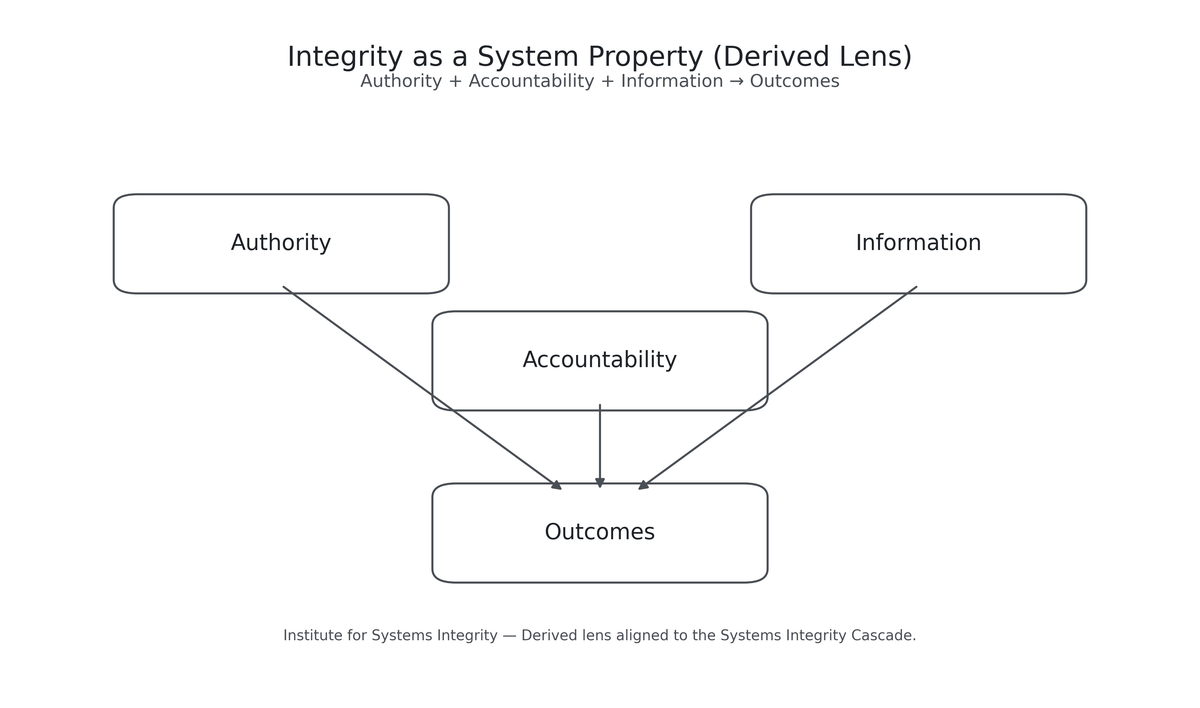
Authority + Accountability + Information → Outcomes
Integrity is sustained when these three elements reinforce one another.
When they are misaligned, even capable and ethical people are structurally constrained — and outcomes degrade.
The three alignment domains
Authority
Who has the power to decide, act, and allocate resources?
Under system stress, authority often concentrates or shifts informally. People may be expected to deliver outcomes without having the authority to change the conditions that produce them.
Accountability
Who is held responsible for outcomes?
Accountability frequently operates retrospectively, focusing on individuals after harm occurs. When accountability is not matched with authority and information, it becomes punitive rather than corrective.
Information
What is visible, reported, and escalated?
System stress distorts visibility. Weak signals are filtered out. Reporting compresses complexity. Decision-makers receive partial or delayed versions of reality.
Integrity as an emergent property
Integrity does not arise from any one of these elements alone.
It emerges from their interaction.
When:
- Authority exists without accountability
- Accountability exists without authority
- Information exists without escalation
Systems create conditions where even ethical actors are structurally constrained.
Outcomes then reflect system design, not individual virtue.
Relationship to the Systems Integrity Cascade
This lens is a derived view of the Systems Integrity Cascade
The Cascade explains how:
- System conditions shape decision integrity
- governance mediates visibility
- Failure dynamics normalise drift
- outcomes emerge over time
The Integrity Alignment Lens explains why those outcomes occur when alignment breaks.
Together, they form a coherent governance architecture.
Applied in
- Integrity Is a System Property (to follow)
- Why Oversight Fails Under Pressure
- Decision-Making Under System Stress
Citation
Institute for Systems Integrity (2026).
Integrity as a System Property: Authority + Accountability + Information → Outcomes.
Derived from the Systems Integrity Cascade.
systemsintergrity.org
© 2026 Institute for Systems Integrity. All rights reserved.
Content may be quoted or referenced with attribution.
Commercial reproduction requires written permission.