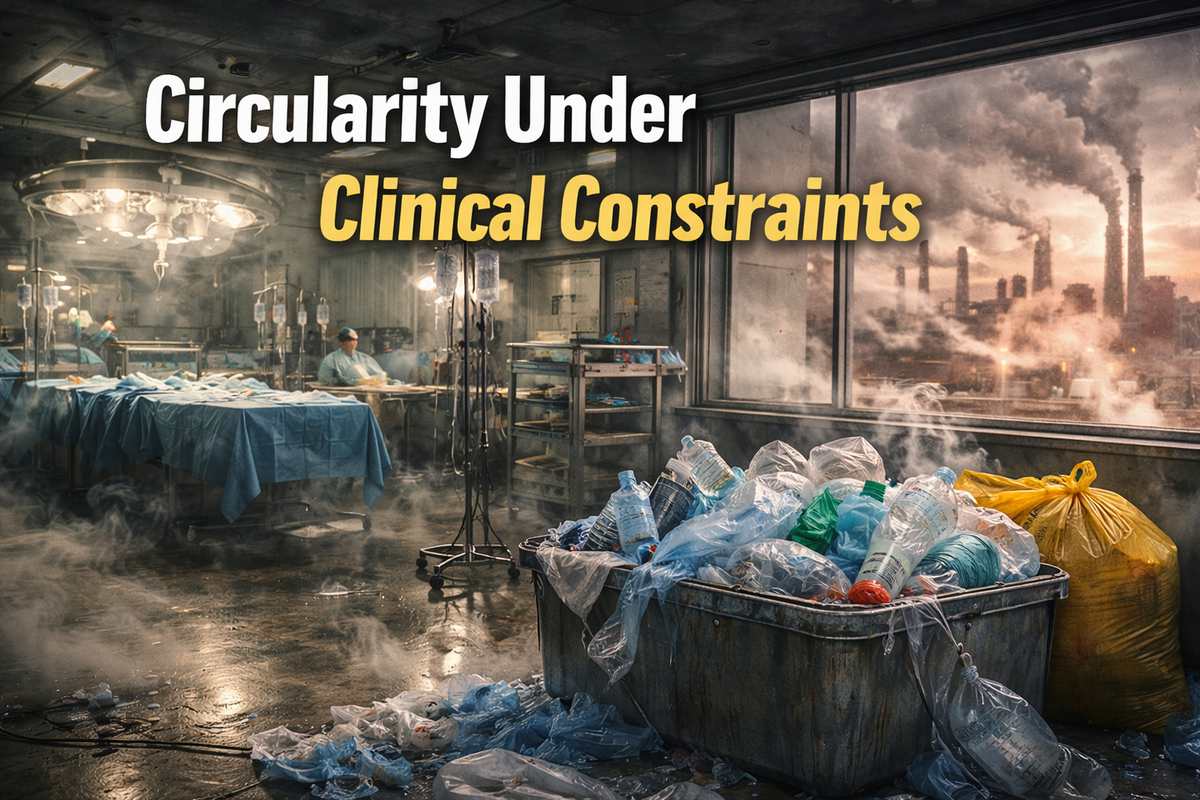
Circularity Under Clinical Constraints: Why recycled material claims do not guarantee circular outcomes in healthcare
Healthcare increasingly adopts recycled-content materials in the name of sustainability. But recycled inputs do not guarantee circular outcomes. Clinical safety, contamination risks, regulation, and waste pathways often reshape the lifecycle reality.
Dr Alwin Tan, MBBS, FRACS, EMBA (Melbourne Business School)
Senior Surgeon | Governance Leader | HealthTech Co-founder
Harvard Medical School — AI in Healthcare
Australian Institute of Company Directors — GAICD candidate
University of Oxford — Sustainable Enterprise
Institute for Systems Integrity (ISI)
Executive Summary
Healthcare systems are under growing pressure to demonstrate environmental sustainability. Recycled-content products — particularly plastic-derived textiles — are increasingly presented as evidence of circular progress.
Yet a critical distinction is often blurred:
Recycled is an input claim. Circular is a system outcome.
In healthcare, clinical safety, contamination risks, regulatory constraints, and end-of-life pathways fundamentally shape what circularity can realistically mean. Products that appear sustainable at the label level may still follow linear material flows in practice.
From a systems integrity perspective, the risk is not poor intention — but signal distortion, where visible sustainability metrics obscure underlying lifecycle realities.
The Appeal of Recycled Content
“Made from recycled plastic” is a powerful proposition.
It is:
✔ simple
✔ measurable
✔ reportable
✔ reputationally attractive
Recycled content fits neatly into ESG frameworks and procurement scorecards.
But simplicity can conceal complexity.
A product may contain recycled inputs while:
❌ lacking viable recovery pathways
❌ degrading material value
❌ generating unintended externalities
Circularity cannot be inferred from composition alone.
When Circularity Breaks at the System Level
Circular systems require materials to:
✔ circulate repeatedly
✔ retain functional value
✔ be recoverable at end of use
In packaging streams, PET bottles often benefit from relatively mature collection and recycling systems, including bottle-to-bottle pathways under controlled conditions (Benyathiar et al., 2022).
Textiles operate under different constraints:
• fibre blends
• dyes and finishes
• contamination
• complex sorting
• weak recycling infrastructure
Consequently, many bottle-to-textile flows become:
bottle → textile → waste
rather than:
textile → textile
(SYSTEMIQ, 2023).
The Competition Effect
Redirecting recyclable PET from bottle-to-bottle loops into textiles may weaken higher-value recovery systems.
A product-level sustainability gain can coexist with a system-level circularity loss (Changing Markets Foundation, 2023).
This reflects a common integrity failure:
Optimising visible outcomes while degrading invisible system performance.
Microfibres: Leakage Beyond the Waste Bin
Synthetic textiles shed microfibres during washing and wear.
UNEP has identified textile-derived microfibres as a significant environmental concern and highlights mitigation strategies (UNEP, 2019).
This introduces a further tension:
A recycling initiative may reduce solid waste metrics while increasing diffuse environmental leakage.
Without lifecycle-wide evaluation, sustainability signals may mislead.
Healthcare’s Boundary Condition: Safety
Healthcare differs fundamentally from consumer sectors.
Material choices are constrained by:
🛡 Infection prevention
🛡 Barrier integrity
🛡 Regulatory compliance
🛡 Patient safety
Once textiles are clinically contaminated, recovery options narrow sharply. Disposal pathways frequently default to incineration or landfill (UNEP, 2022; Hasan et al., 2023).
In this context:
End-of-life systems often determine sustainability outcomes more than recycled inputs.
Circularity cannot compromise clinical safety.
Systems Integrity Risks
ISI observes recurring patterns when sustainability initiatives are poorly aligned with operational realities:
❌ Signal distortion
❌ Value degradation
❌ Risk displacement
❌ Circularity theatre
These failures arise when:
• metrics replace mechanisms
• narratives replace lifecycle analysis
• product claims replace system evaluation
Well-intended interventions can destabilise systems when upstream and downstream conditions are ignored.
Designing Integrity-Compatible Circularity
Healthcare-credible circular strategies prioritise:
Upstream Design
✔ Reduce material intensity
✔ Prefer mono-materials where feasible
✔ Avoid blends blocking recovery
Use-Phase Value Retention
✔ Extend durability and lifespan
End-of-Life Realism
✔ Specify actual recovery pathways
✔ Recognise incineration-dominant flows as linear
Leakage Mitigation
✔ Address microfibre release
✔ Integrate filtration / laundering controls where appropriate
Circularity must be systemically achievable, not symbolically declared.
Governance Reframing
Healthcare leaders should shift from asking:
“Is this recycled?”
to:
“Does this intervention strengthen safety, lifecycle recovery, and environmental outcomes?”
Because:
✔ Recycled inputs do not guarantee circular flows
✔ Circular claims do not guarantee integrity
✔ Sustainability metrics do not guarantee sustainability performance
Conclusion
Circularity in healthcare is neither straightforward nor purely technical.
It is constrained by:
• clinical safety
• contamination control
• regulatory frameworks
• infrastructure realities
• human factors
From a systems integrity perspective:
Circularity must be demonstrated at the system level, not inferred from recycled material claims.
Otherwise, organisations risk mistaking improved optics for improved outcomes.
References
Benyathiar, P. et al. (2022) ‘Polyethene terephthalate (PET) bottle-to-bottle recycling’, Polymers, 14(12).
Changing Markets Foundation (2023) Spinning Greenwash.
SYSTEMIQ (2023) Circular PET and Polyester Report.
UNEP (2019) Fashion’s Tiny Hidden Secret.
UNEP (2022) Single-use Face Masks and Alternatives.
Hasan, M. et al. (2023) ‘PPE-derived plastic pollution’, open access article.
European Commission (2022) EU Strategy for Sustainable and Circular Textiles.