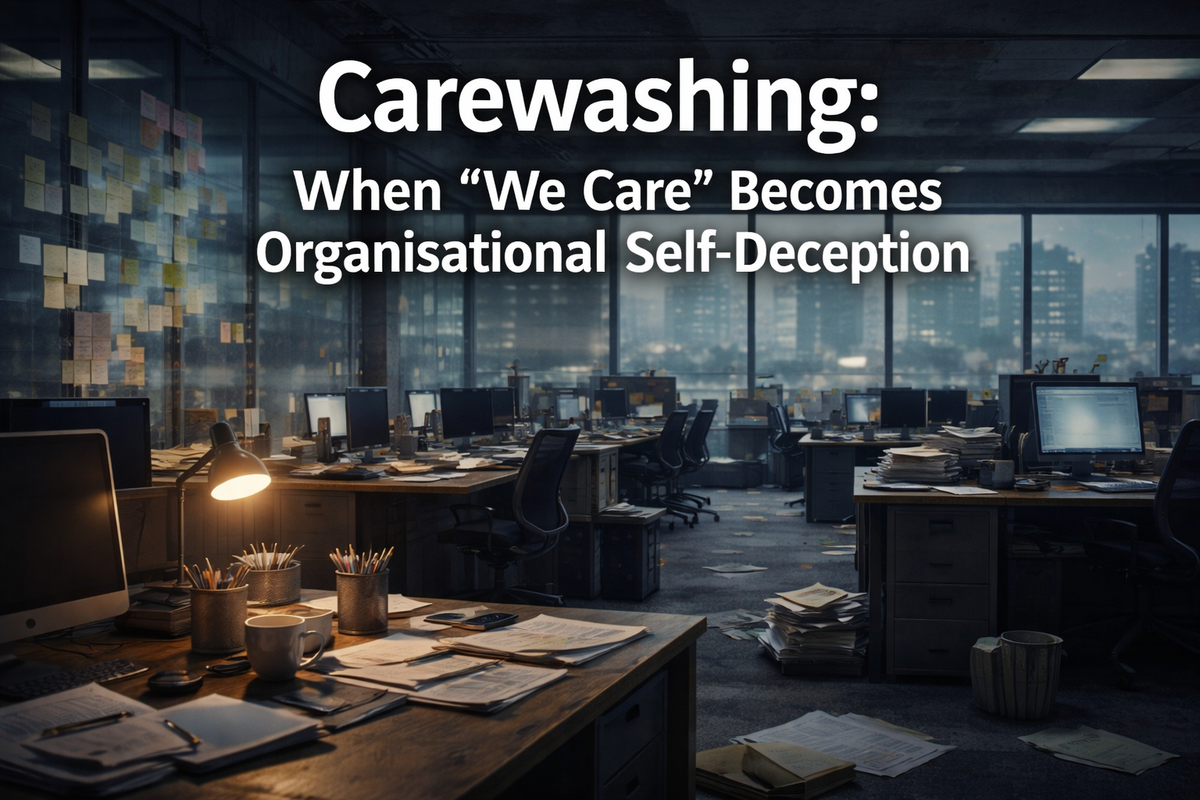
Carewashing: When “We Care” Becomes Organisational Self-Deception
Carewashing occurs when organisations signal care for employee wellbeing while the structural conditions shaping work remain unchanged. When wellbeing messaging replaces real system redesign, trust erodes, and psychosocial hazards persist beneath the language of care.
Assoc. Prof. Nainaben Dhana DCRT (London), HDRT( South Africa) Grad Cert EBP ( Monash) , ACA registered Counsellor
RT Education and Quality Lead, Adjunct Industry Associate Professor of RMIT, AUSCEP participant (2025-26) &
Dr Alwin Tan, MBBS, FRACS, EMBA (Melbourne Business School)
Senior Surgeon | Governance Leader | HealthTech Co-founder
Harvard Medical School — AI in Healthcare
Australian Institute of Company Directors — GAICD candidate
University of Oxford — Sustainable Enterprise
Institute for Systems Integrity (ISI)
Executive Summary (Board & Executive Lens)
Carewashing emerges when organisations signal care for employee wellbeing while the structural conditions shaping daily work remain materially unchanged.
This misalignment is rarely intentional.
Yet its consequences are significant.
Harvard Business Review describes carewashing as the gap between organisational expressions of care and employees' lived experience — a divergence that can alienate employees rather than reassure them.
Gallup’s 2024 data underscore the credibility challenge: only 21% of employees strongly agreed their organisation cares about their overall wellbeing.
At the same time, psychosocial hazard research consistently identifies dominant risks arising from:
- job demands
- organisational change practices
- perceptions of organisational justice
Meanwhile, Employee Assistance Program (EAP) outcome studies demonstrate measurable improvements in individual vocational well-being.
ISI interpretation:
Carewashing risk intensifies when organisations mitigate human distress while leaving hazard exposures insufficiently controlled.
Reframing the Issue
Most organisations genuinely intend to support employees.
However, carewashing often arises when leaders prioritise visible wellbeing initiatives over system redesign.
The organisation communicates:
“People first.”
“Wellbeing matters.”
“We care.”
Yet employees experience:
chronic overload
capacity mismatches
poorly managed change
inconsistent decision processes
strained workplace relationships
Employees evaluate care through operational reality, not organisational messaging.
When rhetoric and lived experience diverge, credibility deteriorates.
Definitions That Matter
Carewashing
When organisational expressions of care outpace the lived experience of work.
Wellbeing-washing
Superficial or illusory commitments to wellbeing are lacking in alignment with systemic drivers.
ISI Framing — Risk Displacement
Carewashing functions as a form of risk displacement, shifting responsibility for managing psychosocial strain from:
➡ organisational design and controls
to
➡ individual resilience and coping
This substitution represents the core integrity failure.
The Carewashing Mechanism
Carewashing frequently follows a predictable systems pattern:
Step A — Stress Accumulates
Demand rises.
Capacity lags.
Complexity increases.
Step B — Signals Are Managed
Wellbeing campaigns launched.
Resilience initiatives introduced.
Care messaging amplified.
Step C — Narrative Stabilises
The organisation appears responsive.
Leadership intent becomes visible.
Step D — Humans Absorb Strain
Hazards persist.
Overload normalised.
Endurance rewarded.
Outcome:
Care becomes performative rather than structural.
Psychosocial Hazards Are System Properties
Psychosocial hazards are increasingly recognised within WHS and ISO frameworks.
Validated hazard assessments identify recurring systemic exposures:
- excessive job demands
- low job control
- poorly managed organisational change
- role ambiguity
- inadequate support
- bullying, conflict, aggression
These are properties of:
➡ work design
➡ governance systems
➡ organisational processes
· change management
· Organisational justice
Not deficits of employee resilience.
The Support Paradox
EAP outcome studies demonstrate:
reductions in distress
improvements in coping
enhanced vocational wellbeing
Support mechanisms are therefore:
valuable
necessary
But they primarily function as:
➡ impact mitigation controls
They do not inherently eliminate:
➡ hazard exposures
When organisations rely disproportionately on support without redesign and data-driven insight :
Symptoms reduce
while
Drivers persist
Governance & Risk Implications
Carewashing generates systemic exposure
Credibility Risk
Trust deteriorates when claims diverge from experience.
Hazard Persistence
Wellbeing narratives may obscure unresolved structural risks.
Control Substitution
Support initiatives risk replacing hazard controls.
Assurance Distortion
Boards receive well-being activity metrics rather than risk reduction indicators.
Participation ≠ Protection
Programs ≠ Controls
Australia: From Care Narrative to Risk Management
Within Australia’s WHS framework, psychosocial hazards are managed through a risk management approach.
Safe Work Australia’s Model Code of Practice provides structured guidance for:
hazard identification
risk assessment
control implementation
review and assurance
This reframes wellbeing from cultural aspiration to governance accountability.
Care is defined by:
➡ hazard reduction
➡ exposure control
➡ system redesign
What Real Organisational Care Looks Like
ISO 45003 positions psychological health within psychosocial risk management.
Care becomes credible when embedded in:
workload boundaries
capacity governance
change management integrity
organisational justice consistency
manager capability
escalation safety
hazard reduction controls
reality-based metrics
independent assurance
The Care Credibility Test (For Boards)
Which psychosocial hazards sit within enterprise risk oversight?
Where is resilience substituting for redesign?
What changed following employee well-being concerns?
Are managers equipped to reduce psychosocial risk?
Do well-being claims align with operational indicators?
Closing Position (ISI)
Carewashing is rarely deceptive by intent.
It is misalignment by design.
Visible care signals
paired with
persistent hazard exposures
Governance maturity requires shifting from:
“We care about people”
to
“We design work that protects people.”
Reflection: There are measurable benefits of well-implemented EAP interventions. However, awareness needs to be raised about these programs for increased utilisation. Importance of organisations integrating their EAP utilisation and effectiveness data to improve the well-being of their staff.
References (Harvard Style)
Croft, J, Parks, A., & Whillans, A 2024,
‘Why workplace well-being programs don’t achieve better outcomes’,
Harvard Business Review, 18 October.
Gube, M, Mathieu, C & Hennelly, DS 2024,
‘How “Carewashing” Alienates Employees’,
Harvard Business Review, 10 June.
Gallup 2024,
‘Despite Employer Prioritisation, Employee Wellbeing Falters’,
Gallup Workplace, 4 November.
International Organisation for Standardisation (ISO) 2021,
ISO 45003:2021 Psychological Health and Safety at Work — Guidelines for Managing Psychosocial Risks,
ISO, Geneva.
Safe Work Australia 2022,
Model Code of Practice: Managing Psychosocial Hazards at Work,
Safe Work Australia, Canberra.
Webb, B 2024,
Psychosocial Hazards Unveiled: Insights and Solutions for Modern Workplaces,
Converge White Paper, Converge International, Australia.
Webb, B 2024,
The Silent Workplace Crisis: Can EAP Help Solve Psychosocial Risk?,
[ND1] Converge White Paper, Converge International, Australia. - Page, C 2024,
An Analysis of the effectiveness of EAP interventions to Reduce Psychosocial Risk in Employees accessing EAP counselling support, Converge International, Australia.