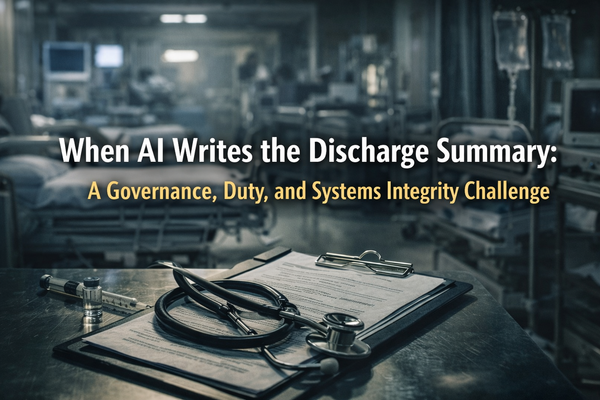
AI Managers vs People Managers: Governance Lessons from Human and Machine Failure Modes
As AI agents move into operational workflows, organisations face a new governance challenge: managing humans and managing autonomous systems are different problems. This article explains why failure modes, controls, and accountability must be designed differently—and what boards must now oversee AI.
Institute for Systems Integrity (ISI)
Co-authors:
Kishore Madhusudanan, B.Tech, CISM, EMBA (Melbourne Business School)
Security Architect | Zero Trust & Cloud Security Resilience Architecture | Executive MBA | Certified Information Security Manager
Dr Alwin Tan, MBBS, FRACS, EMBA (Melbourne Business School)
Senior Surgeon | Governance Leader | HealthTech Co-founder
Harvard Medical School — AI in Healthcare
Australian Institute of Company Directors — GAICD candidate
University of Oxford — Sustainable Enterprise
(Disclaimer: The views and opinions expressed in this post are strictly those of the authors in their personal capacity. They do not necessarily reflect the official policy or position of any current or former employer, organisation, or affiliate.
Artificial intelligence is often described as a technology shift.
From a systems integrity perspective, it is equally a management shift.
Because organisations are no longer managing only people.
They are increasingly managing autonomous, probabilistic, adaptive systems.
And while this change appears incremental — a tool here, an agent there — it introduces a fundamental distinction many leaders still blur:
Managing humans and managing AI systems are not the same management problem.
The Management Category Error
As AI agents move from experimentation to operational deployment, organisations face a subtle but critical risk:
Applying human management assumptions to machine behaviour,
and machine management logic to human performance.
This category confusion distorts oversight, weakens controls, and obscures accountability (Holzinger, Zatloukal and Müller, 2025).
AI systems do not respond to motivation, morale, or encouragement.
Humans do not behave like optimisable control loops.
Yet governance structures frequently fail to distinguish between these domains.
People Managers: Regulating Social Systems
People management operates within deeply human variability shaped by:
• Emotion
• Cognitive load
• Fatigue
• Incentives
• Identity
• Perceptions of fairness
• Trust and psychological safety
Research consistently shows that psychological safety and trust are not cultural luxuries but performance stabilisers(Edmondson, 2018).
When social systems degrade, failure signals include:
Burnout
Disengagement
Silence
Conflict
Attrition
Conduct risk
Controls are therefore primarily relational:
• Leadership capability
• Feedback quality
• Role clarity
• Ethical norms
• Belonging and trust
AI / Agent Managers: Regulating Behavioural Control Systems
AI agents introduce a different form of variability arising from:
• Model limitations
• Data quality
• Environmental drift
• Workflow design
• Prompt structures
• Reward and metric design
• Tool integration
Unlike humans, AI systems:
• Scale instantly
• Fail silently
• Drift gradually
• Produce confident but incorrect outputs
Failure signals often appear as:
Confident errors
Silent degradation
Automation bias
Unintended actions
Cascade effects
Cost amplification
Effective controls therefore differ:
• Observability
• Guardrails
• Drift detection
• Escalation pathways
• Change control
• Incident response
(Srinivasan and Wei, 2026).
Why Governance Must Separate These Domains
Blurring human and AI management creates predictable risks.
1. Misclassified failures
AI errors framed as “technical issues” may actually represent:
Operational risk
Safety risk
Compliance exposure
Reputational harm
(HBR, 2026).
2. Misapplied controls
Algorithmic management literature warns that excessive dashboard-driven control applied to humans can:
Reduce autonomy
Increase stress
Erode trust
Amplify disengagement
(OECD, 2025).
3. Diffused accountability
Autonomous systems complicate responsibility structures.
Who is accountable when an AI agent acts, recommends, or influences decisions?
Research on human control of AI emphasises the need for explicit supervisory and teaming models (Tsamados et al., 2025).
Without clarity, accountability drifts.
Different Systems → Different Failure Modes
Boards must recognise that organisations now operate across two interacting risk landscapes:
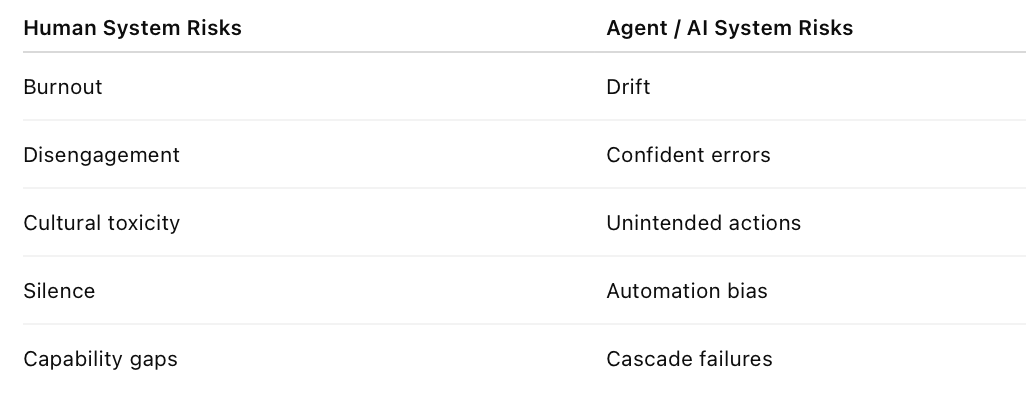
Each requires distinct:
• Monitoring approaches
• Metrics
• Escalation mechanisms
• Assurance models
Governance Questions Boards Should Be Asking
1️⃣ Accountability
Who owns agent outcomes, failures, and harms?
(Srinivasan and Wei, 2026)
2️⃣ Autonomy Boundaries
What decisions/actions are delegated to AI?
(Tsamados et al., 2025)
3️⃣ Observability
How are performance, drift, and anomalies monitored?
(HBR, 2026)
4️⃣ Incident Pathways
Are agent failures treated as operational incidents?
(Holzinger, Zatloukal and Müller, 2025)
5️⃣ Human Impact
How does AI adoption affect workload, autonomy, trust, and stress?
(OECD, 2025)
Systems Integrity Insight
AI does not eliminate management complexity.
It creates a second management discipline.
• People managers regulate relational and social dynamics
• Agent managers regulate behavioural and control dynamics
Governance effectiveness depends on recognising:
Different systems
Different variability
Different failure behaviours
Different control requirements
Conclusion
Organisations that fail to distinguish between human and AI management risk:
• Misapplied oversight
• Hidden vulnerabilities
• Drift in accountability
• Degradation in trust and reliability
Those who design governance explicitly for both domains improve:
Resilience
Safety
Reliability
Decision quality
In the AI era, system integrity depends not only on what technology does —
But on how organisations manage what technology becomes.
References (Harvard Style)
Edmondson, A.C. (2018) The Fearless Organization: Creating Psychological Safety in the Workplace for Learning, Innovation, and Growth. Hoboken, NJ: Wiley.
Harvard Business Review (2026) ‘Are You Ready to Manage AI Agents?’, Harvard Business Review, February.
Holzinger, A., Zatloukal, K. and Müller, H. (2025) ‘Is human oversight to AI systems still possible?’, New Biotechnology, 85, pp. 59–62.
OECD (2025) Algorithmic Management in the Workplace: New Evidence from an OECD Employer Survey. Paris: OECD Publishing.
Srinivasan, S. and Wei, V. (2026) ‘To Thrive in the AI Era, Companies Need Agent Managers’, Harvard Business Review, 12 February.
Tsamados, A., Floridi, L. and Taddeo, M. (2025) ‘Human control of AI systems: from supervision to teaming’, AI Ethics, 5(2), pp. 1535–1548.