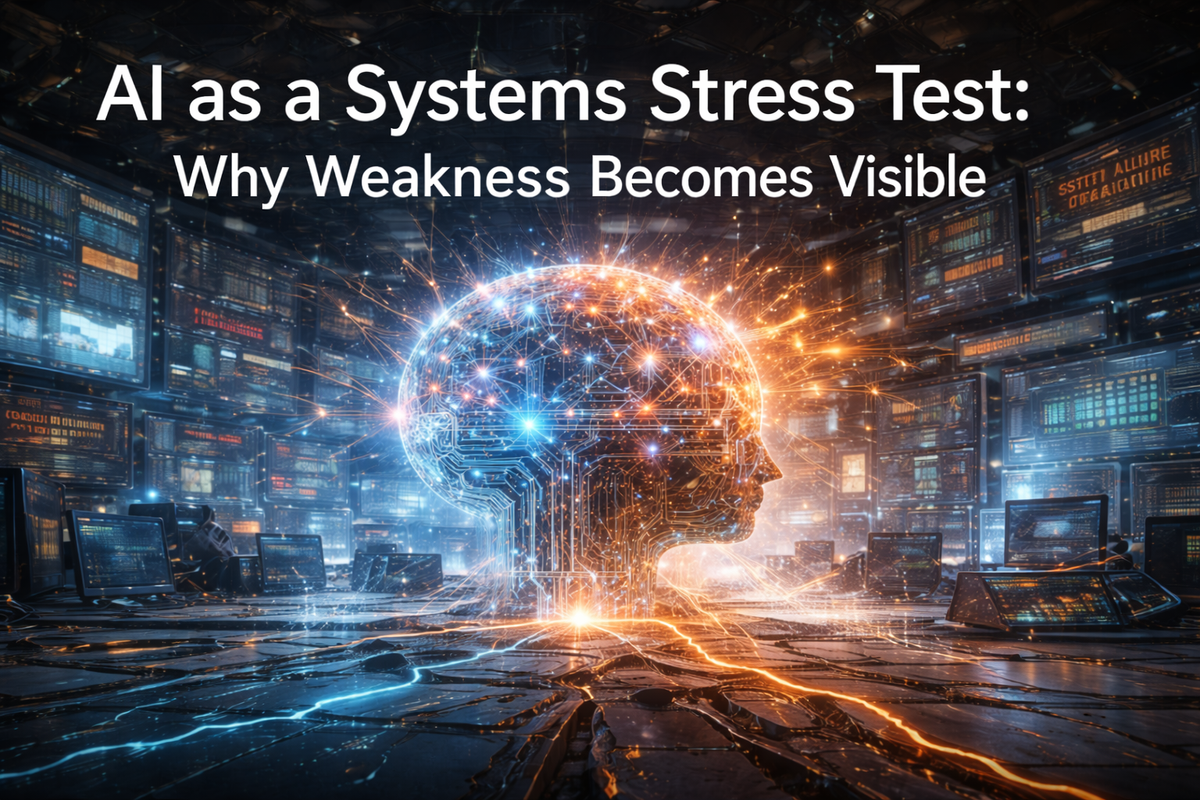
**AI as a Systems Stress Test: Why Weakness Becomes Visible**
Artificial intelligence is often presented as a transformative solution. In practice, AI frequently acts as a stress test for organisational systems. When deployed in complex environments such as healthcare, AI exposes weaknesses in data integrity, workflows, governance, and system readiness.
Dr Alwin Tan, MBBS, FRACS, EMBA (Melbourne Business School)
Senior Surgeon | Governance Leader | HealthTech Co-founder
Harvard Medical School — AI in Healthcare
Australian Institute of Company Directors — GAICD candidate
University of Oxford — Sustainable Enterprise
An Institute for Systems Integrity (ISI) Perspective
Executive Summary
Artificial intelligence is widely presented as a transformative technology capable of improving efficiency, decision-making, and performance across complex sectors such as healthcare.
However, organisational experience increasingly demonstrates that many AI initiatives falter not because of technological limitations, but because they expose deeper systemic weaknesses.
This paper highlights several key insights:
• AI failures are frequently system failures. Workflow incompatibility, governance gaps, and organisational misalignment often explain breakdowns more than model deficiencies.
• AI functions as a systems stress test. Deployment places pressure on data integrity, workflow stability, decision rights, and governance structures.
• Structural weaknesses become visible during AI integration. Fragmented processes, unstable data flows, and unclear accountability quickly become operational constraints.
• Two structural realities shape AI outcomes: value-chain control and technological breadth.
• Scaling breakdown is often predictable. Proof-of-concept success frequently masks systemic limitations that emerge during real-world deployment.
• Human trust remains a critical variable. Resistance reflects uncertainty, perceived risk, and role identity concerns.
• Governance provides the stabilising layer. Model risk ownership, lifecycle monitoring, and accountability structures are essential to sustainable AI integration.
Ultimately, organisations succeed with AI not by expanding pilots but by strengthening the systems into which AI is introduced.
AI as a Diagnostic Force
Artificial intelligence is often described as a catalyst for transformation.
Across healthcare and other complex sectors, AI is expected to deliver greater efficiency, better decisions, reduced costs, and relief for overstretched workforces. These expectations are understandable. Advances in machine learning, predictive analytics, and automation have already demonstrated their potential.
Yet as organisations move from experimentation to real-world deployment, a different pattern often emerges.
AI does not simply improve systems.
It tests them.
When AI technologies are introduced into operational environments, they place pressure on the entire organisational structure. Data systems must become more reliable. Workflows must become more consistent. Governance responsibilities must become clearer. Decisions must be traceable and accountable.
Under these conditions, weaknesses that previously remained hidden beneath everyday operations quickly become visible.
From a Systems Integrity perspective, AI therefore functions less like a standalone solution and more like a diagnostic instrument for organisational resilience.
Why AI Failures Are Often Misdiagnosed
When AI initiatives struggle, explanations usually focus on technical factors such as model performance, algorithm design, or data quality.
These issues certainly matter.
However, experience across industries increasingly suggests that they are rarely the primary cause of failure.
More often, breakdown occurs when technology interacts with organisational systems that were never designed to support it. Workflows may be inconsistent across departments. Data sources may be fragmented. Decision ownership may be ambiguous. Governance processes may not yet exist for algorithm-supported decisions.
Research consistently identifies these systemic factors as major contributors to stalled AI initiatives (McKinsey & Company, 2025; Gartner, 2024).
In many cases, therefore, the failure lies not within the technology itself but within the system attempting to use it.
When Technology Meets Organisational Reality
Unlike traditional digital tools, AI interacts simultaneously with multiple organisational layers.
It depends on data ecosystems, operational workflows, decision structures, governance mechanisms, and human behaviour. When these elements are aligned, AI can dramatically enhance organisational capability.
But when alignment is weak, AI amplifies the underlying instability.
This dynamic explains why AI initiatives often appear successful during early pilots. In controlled environments, data may be curated, workflows simplified, and oversight tightly managed. Once the technology moves into real operational settings, however, the full complexity of the system becomes visible.
The transition from pilot to scale, therefore, acts as a revealing moment. Issues that previously appeared manageable begin to accumulate: workflow disruptions increase, data inconsistencies emerge, costs escalate, and accountability becomes uncertain.
In this sense, AI deployment functions as a stress test of organisational coherence.
Structural Conditions That Shape AI Success
Two structural realities strongly influence whether organisations can integrate AI successfully.
The first is value-chain control. Organisations that control key stages of innovation, implementation, and delivery can redesign workflows and capture the benefits of technological change. Those that depend heavily on external partners, vendors, or regulators may find integration far more difficult.
The second is technological breadth. AI rarely operates in isolation. In healthcare environments, for example, AI solutions often intersect with electronic medical records, imaging systems, monitoring devices, billing platforms, and cloud infrastructure. Each additional layer of integration increases complexity and expands the potential for failure.
As technological interdependence increases, the reliability of AI becomes dependent not only on the algorithm itself but on the stability of the entire ecosystem.
(Bouquet, Wright and Nolan, 2026)
The Predictable Challenge of Scaling
Across industries, a familiar trajectory is visible.
AI initiatives begin with promising prototypes. Early demonstrations produce encouraging results, and enthusiasm grows for wider adoption.
Yet scaling frequently proves difficult.
Operational environments introduce variability that pilot environments cannot fully simulate. Data drift appears as new cases emerge. Workflows require adaptation across departments. Monitoring and governance structures must evolve rapidly.
As a result, some organisations abandon AI initiatives after initial experimentation when the complexity of scaling becomes apparent (Gartner, 2024).
From a systems perspective, such outcomes should not be surprising. They reflect the interaction between advanced technologies and organisational environments that may not yet be prepared to support them.
Human Behaviour and Trust
Technological integration is never purely technical.
AI adoption also depends heavily on human perception and trust. Staff may worry about the implications of algorithmic decision-making, particularly in safety-critical environments such as healthcare. Questions naturally arise about accountability, professional autonomy, and the reliability of machine-generated insights.
These concerns are not signs of resistance to innovation. They are rational responses to uncertainty.
Organisations that successfully integrate AI typically recognise the importance of transparent communication, participatory design processes, and workforce capability development. Building trust becomes as important as building technology.
(NIST, 2023)
Governance as the Stabilising Layer
As AI begins to influence decisions and workflows, governance structures become essential.
Effective governance must address issues such as model risk ownership, lifecycle monitoring, transparency requirements, and ethical safeguards. International frameworks such as the NIST AI Risk Management Framework, ISO/IEC 42001, and the OECD AI Principles provide useful guidance for organisations developing these capabilities.
(NIST, 2023; ISO, 2023; OECD, 2019)
However, governance cannot remain a theoretical exercise. It must be embedded within operational processes so that systems remain stable as technology evolves.
From Exposure to Opportunity
When artificial intelligence exposes organisational weaknesses, it may initially feel like failure.
In reality, it represents an opportunity.
By revealing hidden structural issues, AI provides organisations with the information needed to redesign workflows, strengthen governance, and improve systemic integrity. What appears to be technological disruption is often a form of organisational diagnosis.
Organisations that recognise this dynamic are better positioned to adapt.
Rather than expanding pilots alone, they focus on strengthening the underlying systems that allow technology to function reliably.
Conclusion
Artificial intelligence does not operate independently of the systems in which it is deployed.
It inherits the strengths and weaknesses of organisational structures, workflows, governance frameworks, and culture.
For this reason, AI should be understood as a systems stress test.
Where systems are resilient, AI strengthens capability.
Where systems are fragile, AI reveals structural weakness.
The visibility created by AI should therefore not be seen as a problem. Instead, it offers a powerful opportunity to strengthen the integrity of the systems on which modern organisations increasingly depend.
References (Harvard Style)
Bouquet, C., Wright, C.J. and Nolan, J. (2026) ‘Match Your AI Strategy to Your Organisation’s Reality’, Harvard Business Review, January–February.
Gartner (2024) Gartner Predicts 30% of Generative AI Projects Will Be Abandoned After Proof of Concept by 2025.
Iansiti, M. and Lakhani, K. (2020) ‘Competing in the Age of AI’, Harvard Business Review, January–February.
ISO (2023) ISO/IEC 42001: Artificial Intelligence — Management System Standard.
McKinsey & Company (2025). The State of AI: Global Survey.
National Institute of Standards and Technology (NIST) (2023) Artificial Intelligence Risk Management Framework (AI RMF 1.0).
OECD (2019) Recommendation of the Council on Artificial Intelligence.